New Platforms to Accelerate Oman’s Net Zero Goals: Key Opportunities for Investors and Businesses
MUSCAT, MAY 19 — In a significant advancement toward Oman’s net-zero goals, the Ministry of Energy and Minerals has unveiled three digital platforms and signed two crucial agreements as part of the inaugural phase of its energy efficiency program for government buildings. These initiatives aim to bolster sustainability and drive digital transformation throughout the Sultanate.
Eng. Salim bin Nasser al Aufi, Minister of Energy and Minerals, announced the launch of three strategic digital platforms: the “Makman” platform for open energy sector data, the “Kawader” platform aimed at attracting national talent, and the “Meezan” national platform focused on monitoring emissions and managing greenhouse gas data. These platforms will enable companies to record emissions, track carbon reduction initiatives, and manage data in accordance with international standards.
Al Aufi emphasized that agreements have been signed with specialized firms to implement energy efficiency projects in government buildings. He noted that these initiatives represent a proactive step towards improving electricity consumption efficiency and managing operational costs while supporting sustainability and lowering carbon emissions.
“The National Net Zero Strategy, in collaboration with the Oman Net Zero Centre, has established a clear roadmap for various economic sectors to achieve carbon neutrality by 2050,” he stated. This will involve coordinated efforts with regulatory bodies and organizations, alongside providing necessary technical, legislative, and financial support for emissions reduction projects.
Al Aufi also highlighted the economic potential of Net Zero projects, which promise opportunities for the private sector through the development of innovative products, enhanced production efficiencies, increased local content, and the generation of jobs tied to the green economy.
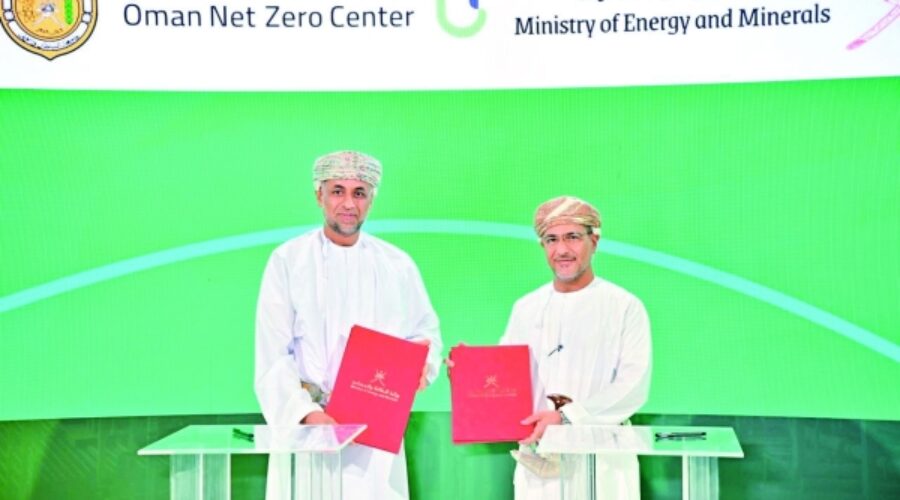
The agreements signed include an Energy Performance Contract (EPC) with Enova Facilities and Energy Management Company and a partnership with Sultan Qaboos University for implementing energy efficiency measures at its facilities.
Dr. Amer bin Saif al Hinai, Vice Chancellor of Sultan Qaboos University for Postgraduate Studies and Scientific Research, remarked that this agreement extends the university’s efforts to manage energy and water consumption. The project entails a suite of technical measures, including upgrading air conditioning and lighting systems, applying energy management systems, and integrating clean energy solutions in line with Oman Vision 2040.
The Oman Net Zero Centre will oversee the energy efficiency initiatives in government buildings following the Super ESCO model, managing contracts and ensuring savings through specialized companies for up to ten years.
Phase one of the program targets 13 government buildings, including 12 at Sultan Qaboos University and one associated with the Royal Court Affairs. This phase will implement an integrated system that involves replacing existing cooling and lighting systems with high-efficiency alternatives, installing smart building management systems, and introducing renewable energy solutions.
The projects aim to decrease electricity consumption by 27.53% relative to the baseline, translating to an annual savings of approximately 14.5 gigawatt-hours and a reduction of about 6,300 tonnes of carbon dioxide emissions each year over a decade.
The Ministry confirmed that this initiative represents the first step in a series of annual programs designed to gradually expand energy efficiency efforts in government buildings across Oman, enhancing operational efficiency while lowering energy costs.
In a move to broaden the national “Meezan” platform for greenhouse gas management, the Ministry, through the Oman Net Zero Centre, has forged partnerships with various national companies and institutions. This effort aims to establish a comprehensive national emissions management system and strengthen public-private collaborations in low-carbon transition projects.
The “Meezan” platform provides a centralized digital infrastructure for greenhouse gas data management, enabling institutions to record data pertaining to fuel consumption, operations, and emissions reduction initiatives, while also calculating their corporate carbon footprint in alignment with Intergovernmental Panel on Climate Change (IPCC) methodologies.
Additionally, the platform complies with ISO 14064 standards for measuring, reporting, and verifying emissions, thus bolstering data reliability and enhancing institutional readiness for regulatory compliance and future participation in the local carbon market.
The Ministry indicated that data garnered through the “Meezan” platform will facilitate national emissions calculations and performance measurements across sectors, aiding the development of data-driven policies and attracting investments in low-carbon solutions.
As part of its digital transformation agenda, the Ministry has also launched an updated version of the “Kawader” platform—formerly known as “PetroJobs”—a unified electronic recruitment platform for the oil and gas sector designed to streamline hiring processes and connect job seekers with operating companies based on transparent, standardized criteria.
Furthermore, the Ministry has initiated the pilot launch of the “Makman” open data platform for the oil and gas exploration and production sector, which is intended to support operating companies, oilfield services professionals, academic institutions, and researchers by improving access to data and enhancing exploration operations’ efficiency.
In addition, the Ministry unveiled its new interactive website, featuring digital services, information, and data related to the energy and minerals sectors, reinforcing its commitment to digital transformation and the enhancement of electronic services across the Sultanate of Oman.
تحليل خاص من عمانت | تصفح سوق عُمان
مساعي عُمان نحو net-zero ambitions through the launch of digital platforms and energy efficiency agreements presents both الفرص والمخاطر for businesses. Companies can capitalize on new green projects و خلق فرص العمل in the sustainability sector, while those slow to adapt may face regulatory challenges and increasing operational costs. المستثمرون الأذكياء should consider engaging in partnerships with the government and leveraging the emerging البنية التحتية الرقمية to enhance their competitiveness in the evolving energy landscape.