Oman’s Mega Pumped Hydro Investment: A Century-Long Energy Asset Boosting Future Business Opportunities
بقلم كونراد برابهو
A groundbreaking upper reservoir planned atop Jabal Abyadh is emerging as the centerpiece of Oman’s ambitious 2-GW Pumped Hydro Energy Storage (PHES) project. Set to become the Middle East’s largest energy storage facility, this initiative represents a pivotal investment in the region’s renewable energy infrastructure.
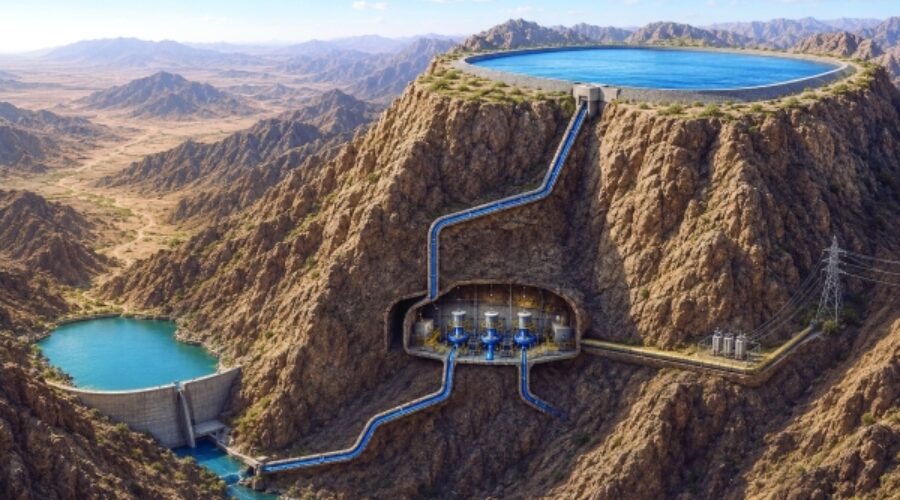
The project is spearheaded by a consortium including EDF Power Solutions, ONEIC – Takhzeen, and Green Universe Enterprise. It capitalizes on a rare geological feature of the Arabian Peninsula—a significant elevation difference between the existing Wadi Dayqah Dam reservoir and the adjacent Jabal Abyadh plateau. This natural terrain forms the basis for a large-scale pumped storage system poised to revolutionize Oman’s renewable energy capacity.
According to EDF, the new upper reservoir will be part of a closed-loop system with an active water volume of approximately 8 million cubic meters (8 hm³). Positioned around 1,130 meters above sea level, it will work in tandem with the lower Wadi Dayqah reservoir to create a gross hydraulic head of roughly 940 meters, ranking it among the highest-head pumped storage projects worldwide.
The hydraulic head is a crucial element of the project’s design and economics. In pumped hydro systems, energy storage and retrieval capacity per unit of water depend heavily on this elevation difference. A higher head generates a greater energy yield, enabling substantial electricity storage with relatively modest water volumes.
Despite its compact active volume, the Jabal Abyadh system is engineered to deliver 2 GW of installed capacity and about 17.9 GWh of energy storage. This allows for continuous electricity generation at full output for up to nine hours.
The system operates by shifting surplus renewable energy from daytime periods to nighttime use. Excess solar photovoltaic electricity—typically generated midday—will pump water from the Wadi Dayqah reservoir through underground tunnels to the upper reservoir on Jabal Abyadh. When electricity demand spikes in the evening or renewable generation diminishes, water is released downhill through reversible pump-turbines, producing electricity almost instantaneously.
A distinctive feature of the project, as highlighted by Dr. Yves-Laurent Beck, Senior Business Developer for Hydropower Projects at EDF Power Solutions Middle East, is its strategic use of existing national infrastructure. The lower reservoir is the Wadi Dayqah Dam, a vital water asset originally built for flood control and groundwater recharge. Its total capacity of about 100 million cubic meters provides a stable and valuable foundation for pumped storage.
Utilizing an existing reservoir rather than building a new lower basin significantly reduces civil engineering demands, environmental impact, and capital costs.
Dr. Beck emphasized that the powerhouse will be housed in a large underground cavern carved into the mountain. This cavern will host multiple reversible pump-turbines, transformers, and related electromechanical equipment. The underground design reduces the surface footprint, improves environmental integration, protects operations from Oman’s harsh climate, and benefits from the region’s geological stability—an essential factor for large underground hydropower projects.
Central to the project’s efficiency is the approximately 1,000-meter elevation difference, which allows for high energy density. This means smaller water volumes can generate substantial electricity, enhancing efficiency and minimizing spatial requirements. The project’s 8 million cubic meters of active water volume underscores the advantages of high-head systems.
Additionally, the project will incorporate variable-speed pump-turbines, a recent technology advancement. Unlike traditional fixed-speed units, variable-speed machines offer a broader operating range and better responsiveness to fluctuations in the power grid. This is especially valuable in solar-heavy systems, aiding smoother integration of intermittent energy and reinforcing grid stability, while allowing rapid responses to changing electricity demand.
Beyond technical merits, Dr. Beck characterized the Jabal Abyadh PHES project as a long-term national asset with an operational life potentially spanning 100 years. Pumped storage facilities typically require low maintenance and have lower lifetime operating costs compared to gas-fired peak plants.
He projected that about 70% of the total project expenditure will remain within Oman, reflecting the civil engineering-intensive nature of pumped storage works—encompassing dam construction, tunneling, underground excavations, and other infrastructure. This will generate significant local employment, contractor involvement, and economic value.
Upon completion, the Jabal Abyadh PHES is set to become the Middle East’s largest pumped hydro facility, playing a critical role in Oman’s transition to a more flexible, low-carbon power system.
تحليل خاص من عمانت | تصفح سوق عُمان
The Jabal Abyadh 2-GW Pumped Hydro Energy Storage project represents a game-changing renewable energy infrastructure that positions Oman as a regional leader in sustainable power storage. For businesses, it signals vast opportunities in engineering, construction, and clean energy sectors, while smart investors should consider the project’s strategic advantages of high hydraulic head efficiency and long-term operational lifespan, promising stable returns and bolstered energy security. Entrepreneurs can capitalize on the growing demand for innovative grid stabilization technologies and local partnerships as Oman advances its transition to a low-carbon economy.