Unlocking Opportunities: How Oman’s Landfill Gas Power Generation Initiative Impacts Your Business
MUSCAT, APRIL 7 – The Oman Environmental Services Holding Company, known as be’ah, has announced significant advancements in its landfill gas (LFG) utilization projects as part of a broader carbon credit and sustainability strategy.
Moving towards innovative methods, the state-owned waste management utility is shifting from traditional gas capture and flaring techniques to converting recovered methane into electricity. Key sites for these initiatives include the Barka and Al-Multaqa landfills. According to be’ah’s 2025 Annual Report, these projects began in January 2025 and are expected to be completed by July 2026.
At the Barka landfill, the estimated potential for gas recovery is approximately 530 Nm³ (normal cubic meters) per hour, from a total generation potential of around 2,500 Nm³ per hour. This capacity supports a flaring capability of about 600 kW, indicating significant potential for electricity generation from the captured methane.
Similarly, the Al-Multaqa landfill is projected to recover around 430 Nm³ per hour from a total generation potential of 2,000 Nm³ per hour, with a flaring system capacity of approximately 460 kW. These figures underlie both the scale of methane emissions being managed and the opportunity to convert substantial amounts of this gas into usable energy.
In discussing the progress of landfill gas recovery efforts, be’ah stated: “The Barka and Al-Multaqa LFG-to-energy projects are advancing towards commercial structuring. We are currently negotiating with private partners for the offtake of biomethane and for carbon credit monetization in voluntary markets.”
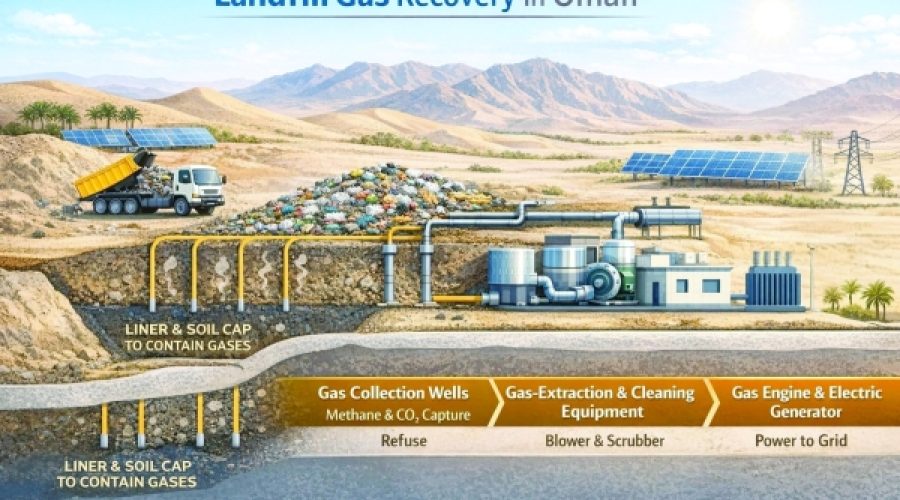
Landfill gas is produced when organic waste decomposes in anaerobic conditions. It mainly consists of methane (CH₄) and carbon dioxide (CO₂), with methane contributing approximately 45–60% of the total mix. This component is significant as it serves both as a potent greenhouse gas and a valuable energy resource that can be harnessed for power generation and industrial use.
Experts indicate that the recovery rates of 430–530 Nm³ per hour at these landfills represent a substantial gain for energy systems reliant on landfill gases. When compared to total generation potentials of 2,000–2,500 Nm³ per hour, these projects effectively capture a meaningful portion of emissions that would otherwise be discharged into the atmosphere.
Across various engineered landfills in the Sultanate, be’ah has established gas collection systems to capture methane produced from the decomposition of organic waste. This gas is systematically extracted through a network of wells and piping, aiding in reducing environmental impact while enhancing overall landfill management practices.
Special Analysis by Omanet | Navigate Oman’s Market
Oman’s push towards landfill gas utilization by advancing projects that convert methane into electricity presents significant opportunities for businesses in the renewable energy sector and waste management. The negotiations for private partnerships signal a burgeoning market for investors, emphasizing the importance of aligning with sustainability goals to capitalize on carbon credit monetization strategies. Smart entrepreneurs should consider positioning themselves in this niche, tapping into the potential for green energy generation while contributing to Oman’s environmental commitments.