Mideast Conflict Spurs Surge in Asian Electric Car Demand: What This Means for Investors and Businesses
Hanoi, Vietnam – Sales of electric vehicles (EVs) have surged across Southeast Asia as consumers seek to counter rising fuel prices fueled by the ongoing Middle East conflict. Asian countries, heavily dependent on crude oil imports and facing limited supply alternatives, have been particularly impacted by the sharp decline in oil shipments.
This energy crisis has significantly benefited Vietnam’s leading EV manufacturer, VinFast, along with Chinese electric vehicle producers. At a VinFast showroom in Hanoi, office worker Do Thi Lan highlighted the financial motivation behind the shift: “We have to calculate our monthly expenses, as the money we spend on petroleum has been rising.” Though her family currently owns a petrol-powered car, she is considering switching to an electric vehicle to reduce costs.
Similarly, school teacher Dao Thi Hue expressed enthusiasm for EVs, citing lower costs and the convenience of avoiding fuel queues. Crude oil prices have climbed about 50 percent since the Middle East conflict began, recently surpassing $100 per barrel, which in turn has driven pump prices higher.
VinFast, which is publicly listed on Nasdaq, recorded a 127 percent year-on-year increase in March sales in Vietnam, delivering 27,600 vehicles. In 2025, electric vehicles accounted for around 40 percent of car sales in the country—a figure that continues to grow.
Pham Minh Hai, VinFast’s deputy sales head, observed that fuel costs have become a critical factor influencing vehicle purchases. “In March, we sold 300 to 400 cars, compared to a usual monthly range of 200 to 250,” he said. Over half of last month’s buyers transitioned from petrol to electric models, with showroom visits rising by approximately 30 percent. To accommodate the increased demand, the showroom has extended its operating hours.
Beyond Vietnam, Chinese EV manufacturers are experiencing robust growth in the region, with BYD—Tesla’s primary competitor—leading the charge. At the recent Bangkok Auto Show, BYD secured more orders than any other manufacturer, surpassing Japan’s Toyota for the first time.
Thai pharmacist Pleng Nawintham, who drives nearly 100 kilometers daily, attributed his interest in EVs to the volatile fuel market, saying, “With the current fuel situation and uncertainty about how long it will last, it’s a major reason for my switch.”
In the Philippines, BYD sales are also booming. Mae Anne Clarisse Bacquiano, manager of a BYD showroom near Manila, reported unprecedented customer traffic driven by rising fuel prices. She recounted a conversation with a doctor eager to switch fully to electric due to high fuel expenses. All BYD stock for the month has already been reserved.
Entrepreneur Arlone Abello, shopping for BYD models, echoed the sentiment that fuel prices are unlikely to drop soon and will continue to drive EV demand.
Facing intense competition in China, BYD aims to expand its international presence, now projecting exports exceeding 1.5 million vehicles in 2026, up from a target of 1.3 million announced earlier this year.
Chinese EV exports to Southeast Asia doubled in March compared to the previous year, according to the China Passenger Car Association (CPCA), emphasizing the region’s growing importance as a market.
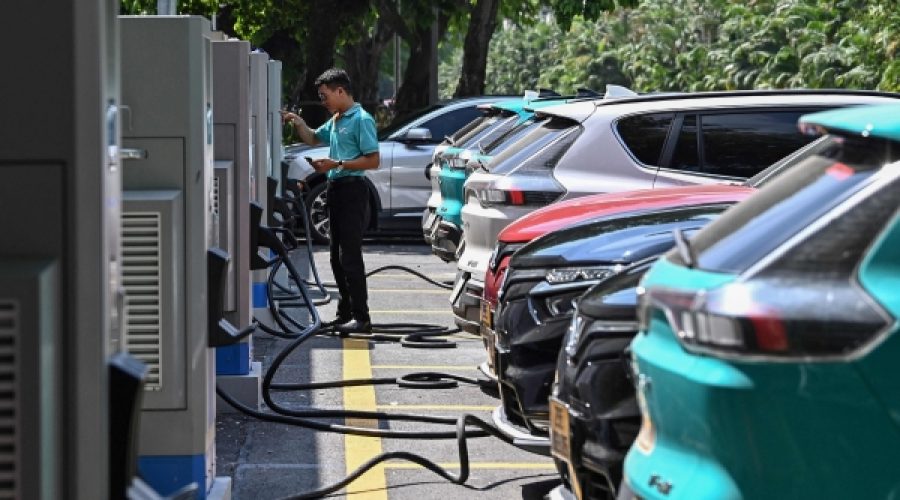
Economic considerations dominate the surge in demand for EVs, with consumers responding to sharp increases in petrol and diesel prices. At the same time, the regional rollout of charging infrastructure is accelerating. Jakarta recently pledged to implement “more serious steps to develop a national electric vehicle ecosystem” in response to its high energy consumption levels.
The momentum for electric vehicles extends beyond Southeast Asia. Capital Economics noted significant global increases in EV registrations, with numbers more than doubling in Japan, South Korea, and New Zealand, and rising over 50 percent in India and Australia in March.
This shift reflects both immediate economic pressures and a broader structural transformation in the automotive market towards cleaner, more sustainable energy solutions.
Special Analysis by Omanet | Navigate Oman’s Market
The surge in electric vehicle (EV) adoption in Southeast Asia, driven by soaring fuel prices amid the Middle East conflict, signals a strategic pivot toward sustainable transportation in the region. For businesses in Oman, this trend highlights new opportunities in EV manufacturing, infrastructure development, and energy diversification, while presenting risks for those heavily reliant on traditional petroleum markets. Smart investors and entrepreneurs should consider harnessing the growing EV ecosystem by investing in charging infrastructure, local production, and cross-border partnerships to capitalize on this accelerating shift.