Oman’s New Carbon Partnership with Japan: What the Green Dividend Means for Investors and Businesses
MUSCAT, MAY 11 — A newly established Joint Crediting Mechanism (JCM) between Oman and Japan is set to facilitate substantial Japanese investment, cutting-edge technologies, and expert technical knowledge across diverse decarbonisation projects within Oman. This was highlighted by Kiyoshi Serizawa, Ambassador Extraordinary and Plenipotentiary of Japan to Oman.
The agreement, formalized last month by both governments, creates a collaborative framework aimed at implementing projects that reduce or eliminate greenhouse gas emissions. These efforts support the climate objectives of both nations under the Paris Agreement.
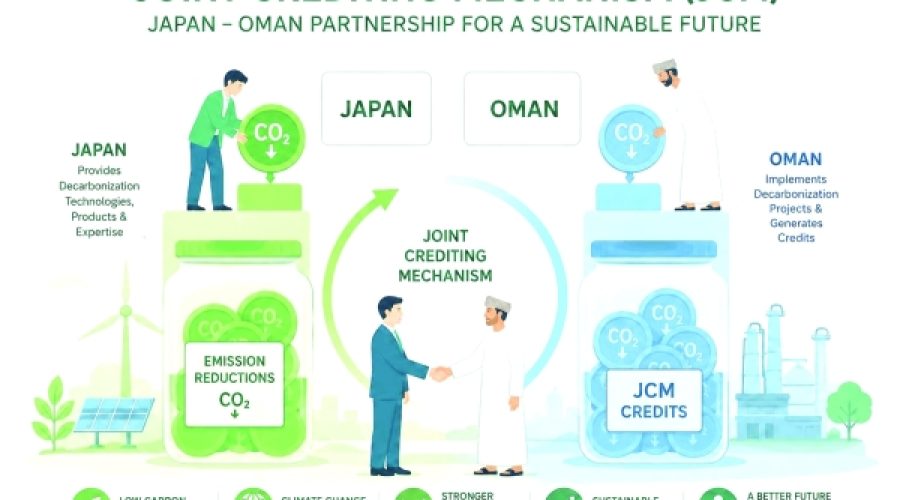
Signed in Muscat by Eng Salim bin Nasser al Aufi, Minister of Energy and Minerals, and Ambassador Serizawa, the mechanism allows a portion of the carbon credits generated from approved projects in Oman to be applied towards Japan’s nationally determined contributions (NDCs). Simultaneously, this supports Oman’s pursuit of its net-zero targets.
In an interview, Ambassador Serizawa described the JCM as a potentially transformative platform that can accelerate Oman’s transition to a low-carbon economy. He emphasized that the mechanism will notably enhance Oman’s appeal for foreign investment, especially from Japanese companies specializing in decarbonisation technologies.
A key advantage is the availability of Japanese government subsidies. Projects that meet certain criteria and gain approval can receive financial backing from the Japanese government, reducing initial investment burdens for Japanese firms. This financial support, paired with the framework’s transparency and credibility, provides strong incentives for Japanese companies exploring international clean energy and sustainability investments.
Ambassador Serizawa noted that the mechanism aligns with the Paris Agreement and involves both governments, enhancing its reliability for Japanese enterprises considering investment in Oman. He identified government subsidies and an internationally consistent, transparent framework as the two primary benefits for companies.
The JCM is expected to benefit multiple sectors capable of measurable emission reductions through renewable energy and energy-efficiency initiatives. These sectors include green hydrogen, manufacturing, transportation, waste management, and agriculture. While no priority sectors have been designated yet, any sector achieving measurable greenhouse gas reductions or removals could qualify.
The mechanism will also serve as a major channel for transferring Japanese decarbonisation technologies and expertise to Oman. Since JCM projects will be collaborative between Omani and Japanese partners, this approach encourages knowledge exchange.
“Cooperation from Omani companies is essential,” Ambassador Serizawa said, emphasizing the importance of local partnerships in navigating regulations and engaging with local authorities. Through such collaboration, technology and know-how are expected to flow naturally from Japan to Oman.
Omani private sector companies, including SMEs, will play vital roles throughout the JCM value chain. These firms can contribute in areas such as engineering, construction, ICT services, digital monitoring, operations and maintenance, data management, and equipment installation linked to decarbonisation efforts.
Beyond cutting emissions, the framework is anticipated to generate wider economic benefits for Oman, including job creation, industrial localisation, human capital development, and expanded opportunities for green entrepreneurship. Carbon credits will also be distributed to local participants as incentives.
A cornerstone of the JCM is the establishment of a bilateral Oman-Japan Joint Committee, now being formed, which will include representatives from both governments. This committee will oversee project approvals, review implementation reports, manage operational issues, and confirm the issuance of credits verified by independent third-party organizations accredited under UN or ISO standards.
To ensure transparency and environmental integrity, project operators will conduct continuous monitoring and reporting, while independent verifiers will assess outcomes before credits are issued. This process safeguards against issues such as double counting and ensures alignment with the Paris Agreement.
The mechanism is also expected to aid Oman’s long-term goal of developing a domestic carbon market consistent with Article 6 of the Paris Agreement, which governs international carbon trading and cooperation. Ambassador Serizawa highlighted Japan’s support for global capacity-building initiatives, including the Article 6 Implementation Partnership (A6IP), to assist governments in establishing the necessary legal and technical frameworks for carbon market participation.
While Oman is still in the early stages compared to regional peers like Saudi Arabia, which has completed at least one JCM-related transaction, and the UAE, which is developing its framework, this agreement marks a crucial initial step for Oman’s integration into international carbon market systems.
The Ministry of Energy and Minerals, through the Oman Net Zero Centre, will be the primary Omani counterpart for the JCM, coordinating with entities such as the Environment Authority and the Ministry of Finance.
Industry analysts suggest the JCM could position Oman as a prime destination for climate-focused investment and green industrial development, complementing the Sultanate’s renewable energy and green hydrogen ambitions outlined in Oman Vision 2040 and the Net Zero 2050 pathway.
Image caption: Kiyoshi Serizawa, Ambassador Extraordinary and Plenipotentiary of Japan to Oman.
Special Analysis by Omanet | Navigate Oman’s Market
The new Oman-Japan Joint Crediting Mechanism (JCM) opens a strategic gateway for significant Japanese investment, advanced decarbonisation technologies, and expert knowledge transfer, positioning Oman as a compelling hub for climate-linked ventures. Businesses and investors should leverage this transparent, subsidy-backed framework to engage in renewable energy, green hydrogen, and emissions-reduction projects, while entrepreneurs can capitalize on emerging opportunities in green technology, local partnerships, and carbon credit markets. This collaboration not only accelerates Oman’s transition to a low-carbon economy but also fosters industrial localization, job creation, and sustainable economic diversification aligned with Oman Vision 2040.