RO 5.2 Billion Allocated for Social and Basic Services in 2026 Budget: Key Opportunities for Investors and Entrepreneurs in Oman
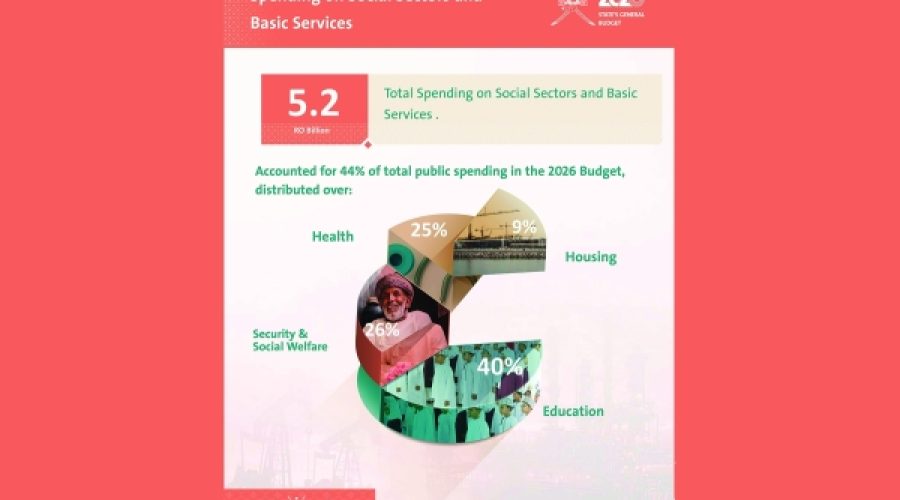
MUSCAT: Oman has allocated RO 5.2 billion for social sectors and essential services in its 2026 State General Budget, highlighting the government’s ongoing commitment to human development, social protection, and the provision of critical public services.
According to the Ministry of Finance, social sector funding represents 44 percent of the total public spending in the 2026 budget. This expenditure primarily targets education, social security and welfare, health, and housing, aligning with the priorities set out in Oman Vision 2040.
Education receives the largest portion of social-sector funding, comprising 40 percent of the total allocation, with RO 2.109 billion dedicated to school education alone. Major initiatives include the construction of 42 new public schools and the delivery of 22 more during the year. The budget also supports the expansion of existing schools to accommodate growing demand across governorates, alongside investments in laboratories, educational resource centers, school furniture, and air-conditioning systems.
Additional funding is allocated for teacher professional development, quality improvement programs, and higher education infrastructure. This includes the construction and equipping of the College of Law at Sultan Qaboos University, renovations at the Universities of Technology and Applied Sciences, outfitting specialized laboratories, and increasing enrollment capacity by 500 students for the 2025/2026 academic year.
Social Security and Welfare sector spending totals RO 1.372 billion, accounting for 26 percent of social-sector expenditure. Of this, RO 614 million supports social protection benefits such as old-age, child, disability, orphan, widow, and family income support. Social insurance programs receive RO 338 million for coverage including old age, disability, and death.
Other allocations include RO 57 million for grants and assistance, RO 280,000 annually for Omani women’s associations across governorates, and RO 126,000 for enhancing rehabilitation services at Al-Wafa Centres and related facilities for persons with disabilities. The Ministry projects that 9,359 cases will benefit from social care and rehabilitation services nationwide.
The housing sector, representing 9 percent of social-sector spending, is allocated RO 464 million. Key measures aim to boost the Housing Bank’s lending portfolio and national housing programs while reducing the current six-month processing time for housing loan approvals. Projects under the 11th Five-Year Development Plan (FDP), worth RO 227 million, are slated for completion during the year.
This allocation also funds infrastructure development at Al-Thuraya City and the completion of the first phase of Sultan Haitham City, both significant urban development projects.
The health sector receives 25 percent of social sector funding with RO 1.318 billion devoted to expanding healthcare infrastructure and enhancing service delivery.
Ongoing hospital construction includes Sultan Qaboos Hospital in Salalah, SamaYil Hospital, Al-Namaa Hospital, the new Madha Hospital, Khasab Hospital, Al-Falah Hospital in Jalan Bani Bu Ali, and the expansion of Nizwa Hospital. The budget also supports new and upgraded health centers in Jalan Bani Bu Ali, Al-Dhariz, Shahb Asayb, Abu Abali, Sur Al-Balush, Ibra, Al-Mudaybi, and a dialysis unit in Barka. Additional projects include the expansion of a health center and the construction of a regional medical warehouse in Musandam Governorate.
The budget further provides for consultancy services at the National Centre for Women and Child Health and strengthens health institutions by enabling the appointment of 3,706 qualified healthcare personnel.
This substantial funding underscores Oman’s strategic focus on advancing key social sectors to ensure sustainable development and improved quality of life for its citizens.
Special Analysis by Omanet | Navigate Oman’s Market
Oman’s RO 5.2 billion investment in social sectors in 2026 highlights a strategic commitment to human capital development aligned with Oman Vision 2040, with a significant focus on education, health, social protection, and housing. For businesses, this signals robust opportunities in education infrastructure, healthcare services, and social welfare initiatives, while smart investors should consider sectors linked to government contracts and social service delivery as key growth areas. Entrepreneurs must align ventures with public sector priorities, especially in education technology, healthcare innovations, and affordable housing solutions, to capitalize on this sustained public spending trend.