Stocks Plunge Amid Greenland Tensions: What Investors Need to Know for Business Stability
President Donald Trump’s escalating confrontation with European leaders over Greenland has sparked significant market turbulence, causing declines in the value of the U.S. dollar, government bonds, and stock markets across the United States and Asia.
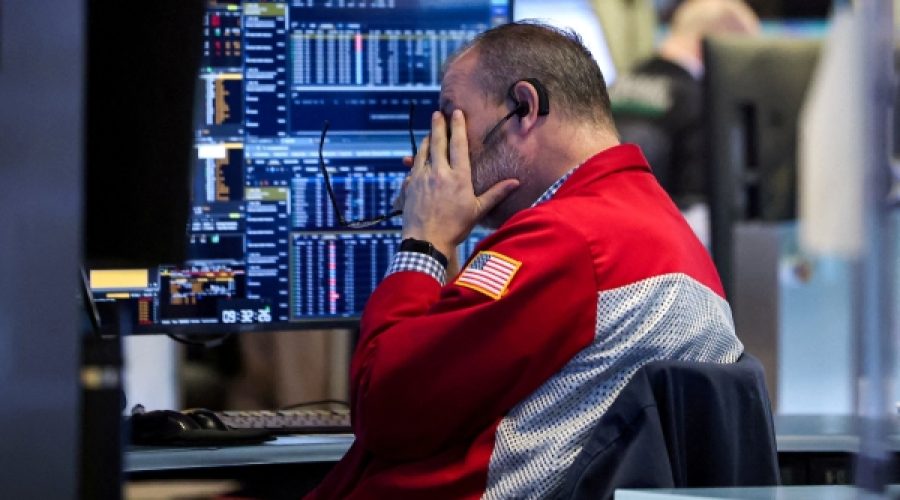
On Tuesday, the S&P 500 index fell more than 2%, marking its sharpest drop since October, as investors reacted to Trump’s warning of increased tariffs on European allies should they fail to support his proposal for the U.S. to acquire Greenland. Concurrently, the VIX volatility index, often referred to as Wall Street’s fear gauge, surged to its highest level since November.
This downturn extended to Asian markets on Wednesday morning, with major indices opening lower. Taiwan’s Taiex index decreased by over 1%, and Japan’s Nikkei 225 dropped 0.5%. The U.S. dollar weakened against the Japanese yen and South Korean won, and futures indicate European markets are also expected to open lower.
Tuesday’s decline in the U.S. was the S&P 500’s largest since April, when Trump first threatened broad tariffs on almost all U.S. trading partners. Despite the market remaining near record highs, this sell-off signals growing investor anxiety about the stability of the global economic order.
Investors, who had previously grown accustomed to geopolitical disruptions having minimal impact on corporate earnings, have become increasingly unsettled in recent days. This shift occurred despite Trump’s optimistic claims of strong stock market performance and U.S. investment during his first year in office.
“We have the hottest country in the world right now,” Trump asserted to reporters.
However, the financial markets conveyed a contrasting narrative. Typically, during geopolitical instability, investors seek safety in U.S. assets such as the dollar and government bonds. Yet, on Tuesday, both the dollar and U.S. government debt declined, indicating a potential “sell America” trend as investors moved away from American holdings.
Eric Teal, Chief Investment Officer at Comerica Wealth Management, advised a defensive strategy amid the current uncertainty, recommending geographic and sector diversification.
The dollar index, which measures the currency against a basket of major trading partner currencies, dropped by 0.8%. The dollar also weakened against the euro, British pound, and Norwegian krone. In contrast, the Swiss franc, another safe haven currency, strengthened nearly 1% against the dollar. Gold and oil prices rose as well, with gold increasing by 1.8%, reflecting cautious investor sentiment.
The yield on the 10-year U.S. Treasury note, inversely related to its price, climbed to its highest point since August, suggesting a drop in bond prices. This yield holds global significance as it influences interest rates for consumer and corporate borrowing. Rising yields counter President Trump’s efforts to lower borrowing costs. Treasury Secretary Scott Bessent cited increasing bond yields in Japan as contributing to the rise in U.S. yields.
Andrew Brenner, Head of International Fixed Income at National Alliance Securities, noted that Trump “has a path to lower rates and a less controversial path with Greenland, but the question is, will he take it?” He cautioned investors to prepare for “major volatility.”
Tuesday marked the first U.S. trading day since Trump’s weekend escalation toward Europe regarding Greenland, with Monday’s markets closed for the Martin Luther King Jr. holiday.
Despite the modest sell-off, major stock indices remain near record levels following a third consecutive year of double-digit gains in 2025.
At the World Economic Forum in Davos, Switzerland, Commerce Secretary Howard Lutnick defended the Trump administration’s “America First” policies amid investor and trading partner unease.
“Everyone said, ‘You are going to do all these tariffs, you are going to destroy the world,’” Lutnick said. “The world’s stock markets are up. Which ones of them? All of them.”
While investors have largely ignored geopolitics in recent years due to limited corporate impact, the recent market volatility reveals increased apprehension over the administration’s aggressive stance toward a European ally’s territory.
In commodities, oil prices declined as geopolitical tensions and expected U.S. crude inventory build-ups overshadowed a temporary production halt at two major oil fields in Kazakhstan. West Texas Intermediate crude for March delivery dropped 1.31% to $59.57 per barrel.
Gold reached a new record high, rising 0.8% to $4,806 an ounce, while silver increased 0.4% to $95.01, close to the record peak of $95.87 hit on Tuesday.
This report originally appeared in The New York Times.
Special Analysis by Omanet | Navigate Oman’s Market
The escalating geopolitical tensions between the U.S. and Europe, highlighted by Trump’s standoff over Greenland, have sparked increased market volatility and a notable retreat from U.S. assets. For businesses in Oman, this underscores the importance of diversification and cautious investment strategies amid global uncertainty. Smart investors and entrepreneurs should focus on geographic and sector diversification while exploring opportunities in traditionally safer assets like gold and potentially less impacted markets, positioning themselves to mitigate risks from erratic global trade policies.