Middle East Space Programmes Shift Focus: What This Means for Investors and Business Growth in Oman
MUSCAT: The Middle East’s space sector is quietly undergoing a significant transformation, shifting from high-profile missions to economically driven programs focused on sustainability, private investment, and practical downstream benefits.
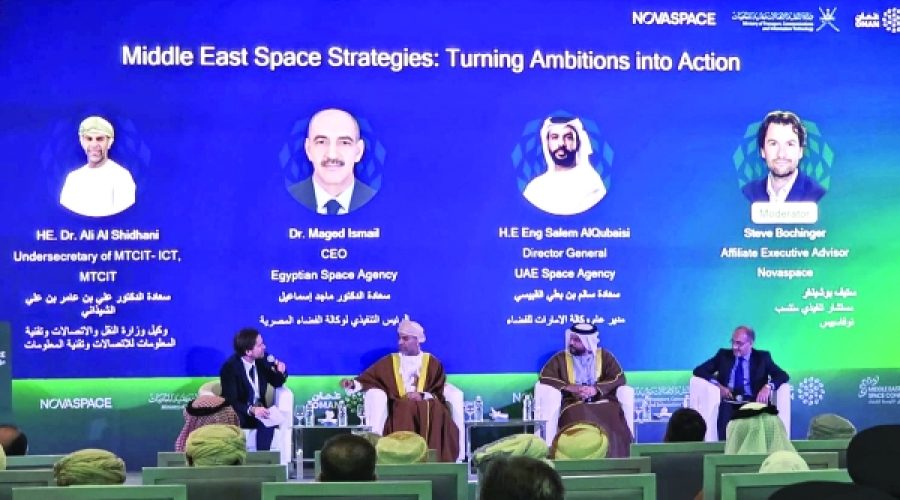
This shift was highlighted during a high-level panel at the Middle East Space Conference in Muscat, where senior officials from Oman, the UAE, and Egypt detailed how their regional space strategies are being reoriented to deliver measurable economic and social outcomes.
For the UAE, this transition has been strategic and deliberate. Eng. Salem Al Qubaisi, Director General of the UAE Space Agency, explained that the country has moved beyond a broad-based support model towards a focused “new space” approach.
“Our current strategy emphasizes enabling innovators, attracting international investors, and ensuring that companies not only survive but thrive within the UAE,” Al Qubaisi stated.
A key element of this approach is a strong legislative and regulatory framework aimed at minimizing obstacles for both startups and established companies. Licensing procedures that previously took months have been digitized and expedited, with regular updates ensuring regulations keep pace with technological advancements.
“The ease of doing business is essential,” he said. “When companies can license, operate, and scale rapidly, the entire ecosystem naturally expands.”
The UAE is increasingly prioritizing investments in Earth observation, geospatial intelligence, and downstream applications tied to food security, water management, and climate resilience—critical areas where space-derived data supports national policy objectives.
Similarly, Egypt’s focus has shifted toward applied outcomes. Dr. Maged Ismail, CEO of the Egyptian Space Agency, emphasized that human capital development, Earth observation, and public-private partnerships form the foundation of Egypt’s space endeavors.
“Space applications now directly contribute to economic growth,” Ismail affirmed. “From agriculture to urban planning, the value is tangible and measurable.”
A common challenge across the region remains the need for sustained investment. Space programs demand consistent funding, often without immediate returns. Panelists agreed that convincing governments to commit long-term depends on demonstrating clear and visible impacts.
“When decision-makers witness concrete results, securing future funding becomes easier,” Ismail noted.
Human capital development is another shared priority. The UAE’s astronaut program, for instance, has significantly boosted student interest in science and engineering.
“Role models are crucial,” Al Qubaisi said. “Seeing nationals reach space transforms the aspirations of an entire generation.”
International collaboration was unanimously deemed indispensable. The panelists rejected the notion of space as a purely sovereign pursuit, instead framing cooperation—through technology transfer, joint missions, and accelerator programs—as vital for accelerating regional progress.
“International cooperation is essential in space,” said Ismail. “No country can develop a comprehensive ecosystem alone.”
Perhaps the most significant indicator of change is the region’s growing emphasis on downstream markets, where satellites, data, and analytics meet real-world demands. This shift highlights a broader recognition that the Middle East’s space future will be defined less by launches and more by economic relevance.
As regional programs mature, the competitive advantage will increasingly depend not just on ambition but on effective implementation, regulation, and the ability to convert space assets into ground-level value.
Special Analysis by Omanet | Navigate Oman’s Market
The Middle East’s space sector is transitioning from ambitious missions to pragmatic, economically driven programmes emphasizing sustainability, private investment, and downstream applications like food security and climate resilience. For Omani businesses and investors, this shift offers a unique opportunity to engage in emerging high-impact sectors, particularly through innovation, public-private partnerships, and leveraging international collaborations. Smart entrepreneurs should focus on scalable solutions and regulatory agility to capitalize on the growing demand for space-derived data and services that directly contribute to national development goals.