Judicial Innovation Summit: Key AI Developments Shaping Future Courtroom Efficiency for Businesses in Oman
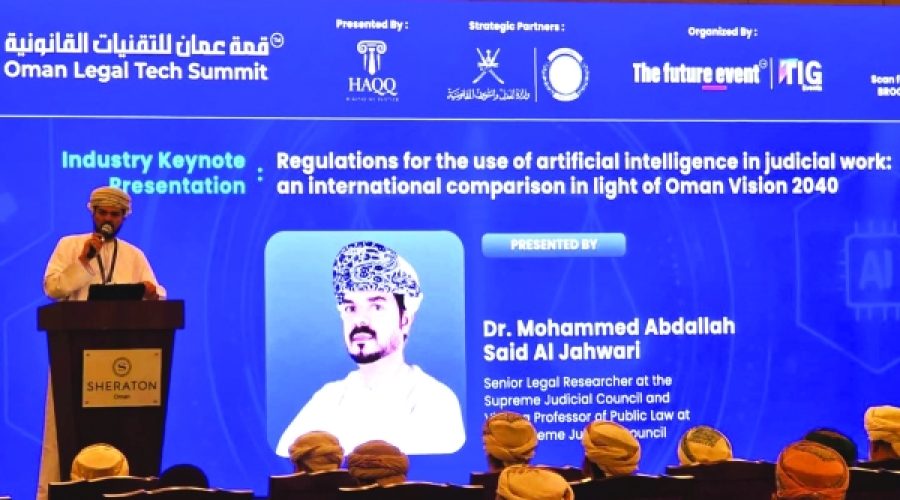
MUSCAT: The Sultanate of Oman is rapidly advancing its digital transformation in alignment with Oman Vision 2040, with the integration of Artificial Intelligence (AI) into the judicial system emerging as a priority. This critical topic was addressed at the Oman Legal Tech Summit 2026, where experts and policymakers convened to explore the balance between rapid technological advancement and ensuring justice.
During a keynote presentation titled “Regulations for the Use of Artificial Intelligence in Judicial Work,” Dr. Mohammed Abdallah Said al Jahwari, Senior Legal Researcher at the Supreme Judicial Council and Visiting Professor of Public Law, provided an in-depth analysis of Oman’s approach to this evolving landscape. He drew comparisons between Omani strategies and international standards, including UNESCO’s 2025 guidelines and judicial AI protocols from the UK.
The “Smart Judge” Dilemma
Dr. Al Jahwari noted the primary challenge lies not in the technology itself but in its governance. He posed a crucial question to the audience of over 500 legal professionals: Can we create a “Smart Judge” that combines the rapidity of machines with the wisdom inherent in human judgment?
“Is AI a tool for enhancing efficiency and swift justice, or could it lead to manipulation and legal loopholes?” he asked.
He emphasized that while AI has the potential to elevate Oman’s position in the AI Government Readiness Index—where it currently ranks in the mid-50s—this progress should not jeopardize the integrity of the judicial system.
Aligning with Oman Vision 2040
The summit, organized by Haqq in strategic partnership with the Ministry of Justice and Legal Affairs and the Oman Lawyers Association, highlighted judicial modernization as a key element of the national roadmap. The Supreme Judicial Council’s operational plan for 2024–2030 includes initiatives such as AI-enabled digital libraries and virtual court proceedings.
However, Dr. Al Jahwari criticized the existing national AI policy from the Ministry of Transport, Communications and Information Technology (MoTCIT), describing it as merely a “general framework.” He advocated for a dedicated Judicial Ethical Charter to specifically address the risks associated with AI in the legal sector.
Lessons from Global Models
Dr. Al Jahwari referenced the UNESCO 2025 Guidelines, which outline 15 principles for implementing AI in courts, particularly stressing the importance of the “Human-in-the-loop” concept. He also highlighted the UK’s updated judicial guidance, which cautions against the phenomenon of “AI hallucinations”—instances where the AI generates statistically probable yet factually incorrect information.
“AI acts as a prediction engine, not a fact engine. It can generate likely responses, but these are not necessarily truths,” he warned, mentioning international examples where AI-created false precedents resulted in sanctions.
The Future of Human Oversight
In concluding his keynote, Dr. Al Jahwari underscored the necessity of accountability. While AI can aid in predicting case outcomes and drafting documents, the inherent “Human Character” of judges remains irreplaceable—especially in criminal law, where context and empathy are vital.
“The integrity of judicial logic must be safeguarded. The human qualities of a judge—their comprehension of circumstances and nuances—are essential in preventing the ‘logic corruption’ that may arise from purely mechanical systems,” he asserted.
As Oman approaches the conclusion of its National Programme for AI (2024-2026), the summit conveyed a clear message: Technology will enhance judicial processes, but it will not supplant the role of the judge.
Special Analysis by Omanet | Navigate Oman’s Market
As Oman accelerates its digital transformation through the integration of AI in the judicial system, businesses should be prepared for a landscape where technology enhances efficiency but mandates ethical governance. This shift presents opportunities for entrepreneurs in legal tech and compliance sectors, while also posing risks related to regulatory ambiguity and potential mismanagement of AI tools. Smart investors should focus on innovative solutions that prioritize judicial integrity, ensuring that legal practices remain robust amidst technological advancements.