Impact of Strikes on Dubai Businesses: How Shutdowns Could Affect Investment Opportunities in the UAE
DUBAI – Recent Iranian strikes across the Gulf have resulted in significant business disruptions, marking the most profound impact on the region since the pandemic. These attacks forced airport closures, halted port operations, and sent shockwaves through financial markets.
The strikes signify an unprecedented escalation for Dubai, a city that has historically insulated itself from regional conflicts. Originally a small fishing village, Dubai transformed into a modern emirate through modest oil revenues, developing ports, airports, and trade centers. In the 1990s, it pivoted towards luxury tourism, real estate, and financial services. According to Vijay Valecha, Chief Investment Officer at Century Financial, “Regionally, the impact across Gulf economies is mixed.” He noted that while elevated oil prices provide fiscal support for producers like Saudi Arabia and Qatar, pressures on trade, logistics, and tourism—especially in the UAE—are likely to increase if shipping risks rise or regional sentiment deteriorates.
STOCK MARKETS DECLINE
On Sunday, Gulf stock markets saw a sharp decline. Saudi Arabia’s benchmark index fell by over 4% at the opening and ultimately closed down 2.2%. Oman experienced a drop of 1.4%, while Egypt lost 2.5%, both adjusting from earlier losses. Uniquely, Kuwait’s exchange suspended trading until further notice. UAE markets, which are closed on Sundays, are set to reopen on Monday. Mohammed Ali Yasin, CEO of Ghaf Benefits in Abu Dhabi, stated, “Markets will continue to be fragile and volatile as long as military actions persist.”
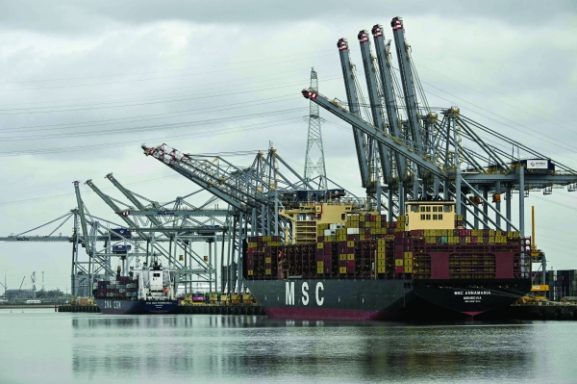
The Iranian strikes targeted various locations, including airports, military installations, ports, and hotels. Both Dubai International Airport and Abu Dhabi’s Zayed International Airport sustained damage; one civilian was killed, and 11 were injured in the incidents. A fire broke out at a berth in Dubai’s Jebel Ali Port following an aerial interception. Notable UAE companies impacted include Dubai developer Emaar Properties and retailer Majid Al Futtaim.
The UAE has also become a hub for global hedge funds and major banks drawn to the vast sovereign wealth managed by ADIA and Mubadala.
RAMADAN NETWORKING DISRUPTED
The timing of these disruptions is particularly impactful, coinciding with the Islamic holy month of Ramadan. This period is marked by corporate iftars and suhoors—significant networking events in the region’s business calendar. The disruption during Ramadan adds an unseen yet substantial cost to the already unfolding chaos.
Strikes also affected residential areas around Dubai Marina and Palm Jumeirah, damaging the Fairmont The Palm hotel and the iconic Burj Al Arab. The Fairmont recently changed hands for $325 million, a deal that signified the surging demand in Gulf hospitality. Consequently, the damage has come to symbolize the toll on the region’s flourishing tourism sector.
Following the attacks, the United States, the UK, and the European Union issued revised travel advisories for the Gulf, urging their citizens to exercise extreme caution and avoid non-essential travel. Major transit airports, including those in Dubai, Abu Dhabi, and Doha, faced closures or severe restrictions as regional airspace remained largely shut.
Staff at international companies are expected to adhere to local guidance regarding remote work in the coming days. The UAE’s federal labor authority has advised businesses to implement remote working arrangements until March 3, emphasizing the importance of keeping employees away from open areas, except for those in essential roles.
Special Analysis by Omanet | Navigate Oman’s Market
The recent escalation of military actions in the Gulf poses significant threats to businesses in Oman, primarily through decreased regional stability which could disrupt trade and tourism. Opportunities may arise for investors in oil and logistics sectors, bolstered by elevated oil prices; however, the potential for heightened risks in the tourism and service industries cannot be overlooked. Smart investors should consider diversifying portfolios to mitigate risks while leveraging the prevailing conditions to explore strategic acquisitions in essential sectors.