Asian Shares Surge as KOSPI Rebounds: What Investors Need to Know About Market Shifts and Bond Slides
TOKYO — Asian stock markets surged on Thursday as U.S. Treasury prices declined, signaling a tentative rebound in risk appetite following market disruptions caused by the escalating conflict in the Middle East.
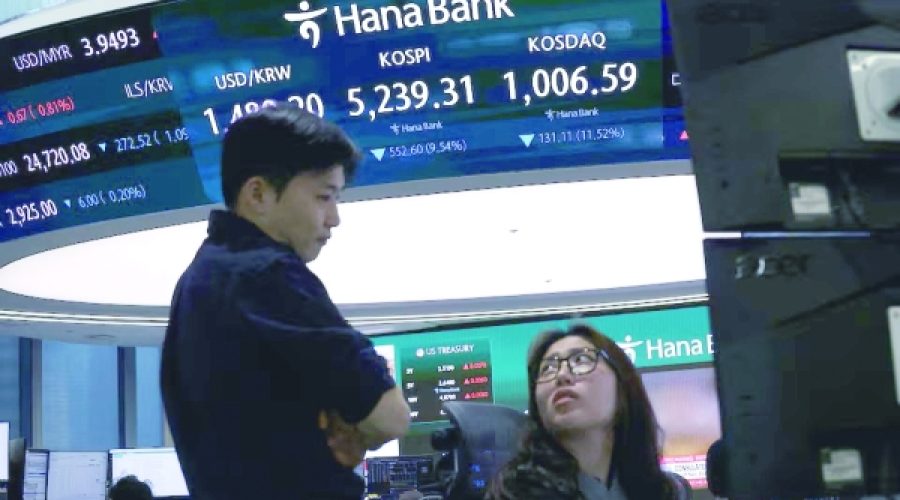
South Korea’s KOSPI index led the regional rally, rebounding sharply after steep losses the previous day, supported by gains on Wall Street. Meanwhile, the U.S. dollar continued its upward trend, and both oil and gold prices rose amid ongoing concerns about energy supply disruptions.
Chinese stocks advanced after Beijing announced comprehensive economic and development targets for 2026. In the United States, the Senate expressed strong support for President Donald Trump’s military operations against Iran, indicating a prolonged conflict that continues to unsettle financial markets, transportation routes, and energy production.
Paco Chow, dealing manager at Moomoo Australia and New Zealand, cautioned, “Geopolitical risk can flare up again very quickly, so any early gains across Asia-Pacific share markets may not last. The outlook remains cautious until oil flows return to normal.”
Asia-Pacific shares, excluding Japan, saw MSCI’s broadest index jump by 3.9%. South Korea’s KOSPI surged 11.2%, recovering from what traders described as a historic plunge, while Japan’s Nikkei climbed 2.5%.
U.S. Treasury yields rose as bond prices fell, with the 10-year yield increasing 3.9 basis points to 4.121% and the 30-year yield rising 4.4 basis points to 4.7607%.
The conflict escalated further as Iran launched missile strikes against Israel early Thursday, shortly after Washington blocked attempts to halt the U.S. air assault.
U.S. Energy Secretary Chris Wright described the impact of the conflict on energy markets as a “bump in the road” and a “small price” for achieving U.S. military objectives. Meanwhile, International Monetary Fund Managing Director Kristalina Georgieva warned that the world may be entering a prolonged period of instability, testing global economic resilience.
Oil prices continued to climb on supply concerns, increasing about 16% since the conflict began. U.S. crude rose 3.94% to $77.60 per barrel, while Brent crude gained 3.5% to $84.25.
Spot gold increased by 0.78%, reaching $5,175.47 an ounce.
China set a GDP growth target of 4.5% to 5% for 2026, a slight decrease from the 5% growth achieved last year. The country also released its 15th Five-Year Plan, emphasizing investments in innovation, high-tech industries, and a significant boost in household consumption. Following these announcements, China’s CSI300 index rose 1.4%, and the Shanghai Composite gained 1%.
The U.S. dollar index increased 0.19% to 98.99. The euro declined 0.21% to $1.1609, and the Japanese yen weakened 0.06% to 157.15 per dollar. In the cryptocurrency market, Bitcoin fell 0.73% to $72,807.71, while Ether declined 0.66% to $2,136.43.
Special Analysis by Omanet | Navigate Oman’s Market
The recent geopolitical tensions in the Middle East have triggered volatility in global markets, with a cautious recovery in Asian shares and rising oil prices highlighting heightened energy supply risks. For businesses in Oman, this underscores the critical need to diversify energy sources and supply chains to mitigate disruption risks. Smart investors and entrepreneurs should consider capitalizing on the elevated oil price environment while preparing for potential market instability driven by ongoing geopolitical uncertainties.