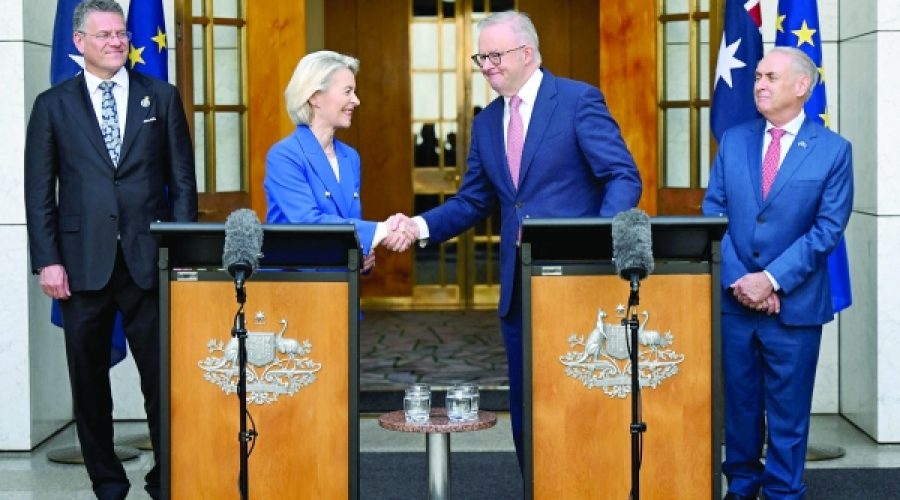
Australia and European Union Seal Minerals Trade Deal: What It Means for Investors and Businesses in the Mining Sector
SYDNEY — After eight years of negotiations, Australia and the European Union have finalized a landmark trade agreement, eliminating tariffs on nearly all European goods and the vast majority of Australian critical mineral exports.
However, certain Australian agricultural products, including beef and sheep meat, will be subject to export quotas. This has drawn sharp criticism from Australian farmers, who described the deal as providing “subpar” access to the European market.
The agreement follows intensified discussions between the two parties amid soaring U.S. tariffs under the Trump administration and growing Western concerns over China’s dominant supply of rare earth elements and other essential minerals. Additionally, Australia and the EU signed a separate pact to enhance security and defense cooperation.
European Commission President Ursula von der Leyen emphasized the shared global outlook between the geographically distant partners. “With these dynamic new partnerships on security and defence, as well as trade, we are moving even closer together,” she stated.
The deal will abolish over 99% of tariffs on EU goods exported to Australia, cutting approximately €1 billion ($1.2 billion) annually in duties for European companies. EU exports to Australia are projected to increase by up to 33% over the next ten years.
Australian Prime Minister Anthony Albanese highlighted the agreement’s economic value, estimating it will contribute around A$10 billion ($7 billion) per year to Australia’s economy. He also stressed the significance of removing nearly all import tariffs on Australian critical minerals entering the EU to stabilize global supply chains.
“For both Europe and Australia, getting China right is a strategic imperative,” von der Leyen told the Australian parliament. “We cannot be over-dependent on any supplier for such crucial ingredients, and that is precisely why we need each other.”
This treaty also underscores Europe’s expanding engagement with the Indo-Pacific region, following trade agreements with Indonesia in September and India in January.
Key Provisions and Agricultural Impact
Australian tariffs will be eliminated immediately on European wine, sparkling wine, fruits, vegetables, and chocolates, with cheese tariffs phased out over three years. While the EU will remove tariffs on many agricultural products, some exports, notably beef—a major contentious issue that previously stalled talks in 2023—will remain constrained by quotas. The EU has set two tariff rate quotas totaling 30,600 metric tonnes for Australian beef, with about 55% of this volume entering duty-free.
Hamish McIntyre, president of Australia’s National Farmers Federation, expressed deep disappointment, stating the deal offers no commercially meaningful agricultural market access improvements since Australia last paused negotiations.
The agreement also grants full protection to several EU ‘geographical indications’ (GIs) such as Pecorino Romano and Ouzo after a brief phase-out period. However, some producers of products like feta cheese will retain the right to use these names if clear labeling of the product’s origin is maintained.
Australia agreed to raise the luxury car tax threshold for European electric vehicles (EVs) to A$120,000 ($83,600), exempting roughly 75% of EV imports from this tax.
Trade interactions between the EU and Australia are significant, with EU goods exports to Australia reaching €37 billion in 2025 and services exports €28 billion in 2023. The EU was Australia’s third-largest two-way trading partner in 2024 and sixth-largest export market, as well as the second-biggest source of foreign investment that year.
— Reuters
Special Analysis by Omanet | Navigate Oman’s Market
The new Australia-EU trade deal highlights a global shift toward diversifying supply chains, especially for critical minerals, which presents Oman with opportunities to position itself as a reliable alternative supplier in the Indo-Pacific and European markets. However, businesses should be mindful of emerging competitive dynamics and potential market access limitations, such as quota restrictions. Smart investors should look to capitalize on expanding trade routes and critical mineral demands while anticipating policy shifts that encourage broader regional economic integration.