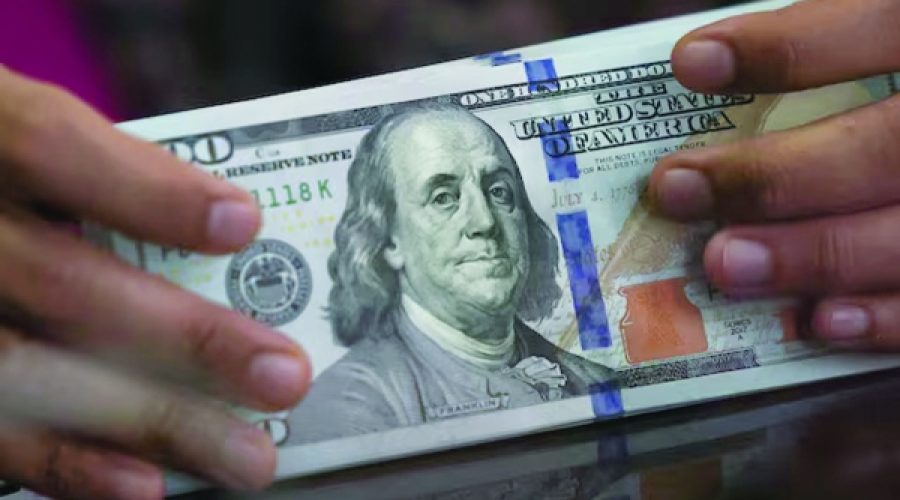
Dollar Near Multi-Year Lows: What Investors and Businesses in Oman Need to Know About Rising Market Risks
The dollar remained near multi-year lows on Thursday as ongoing concerns about US economic policy and geopolitical risks continued to suppress the currency. This occurred despite stabilizing support from Washington and European officials following an earlier market sell-off.
Earlier in the week, the dollar plunged to a four-year low after President Donald Trump appeared to downplay the currency’s weakness. However, the dollar later regained some strength when US Treasury Secretary Scott Bessent reaffirmed Washington’s commitment to a strong-dollar policy.
On the monetary policy front, the Federal Reserve adopted a cautious stance, describing inflation as “somewhat elevated” and the labor market as stabilizing. Investors interpreted these remarks as indicating that interest rates might remain unchanged for a longer period.
Federal Reserve Chair Jerome Powell signaled a prolonged pause before any further rate cuts. Some economists argue that the US economy currently shows little need for additional monetary easing. David Doyle, head of economics at Macquarie Group, stated, “While the outlook remains uncertain, particularly given the appointment of a new Fed Chair in coming months, our baseline remains that the rate-cutting cycle is complete,” adding that the next policy move could be a rate hike in 2026.
The euro, which had briefly risen above $1.20 amid the dollar’s decline, fell back to around $1.1980 after European Central Bank (ECB) officials expressed concerns about the deflationary effects of rapid currency appreciation. ECB board member Isabel Schnabel noted that the policy stance is “in a good place,” with interest rates expected to remain steady for an extended period.
Despite a slowdown in heavy selling, the dollar continued to lose ground against major currencies. It dropped 0.33% against the Swiss franc to 0.766, close to an 11-year low, while the British pound stayed near a 4½-year high at $1.3844.
The Australian dollar reached a three-year high, buoyed by expectations of a potential rate hike as soon as next week. Meanwhile, the Japanese yen gained modestly amid speculation of coordinated action between US and Japanese authorities.
The dollar has fallen about 2% this year, pressured by investor concerns over erratic US policymaking, threats to the Federal Reserve’s independence, and indications that Washington might intervene to weaken the currency. Ray Attrill of NAB remarked, “Loss of independence is far and away the biggest risk to ongoing dollar hegemony.”
Against a basket of currencies, the dollar stood near 96.06, close to Tuesday’s four-year low.
— Reuters
Special Analysis by Omanet | Navigate Oman’s Market
The sustained weakness of the US dollar amid policy uncertainty and geopolitical risks presents both challenges and opportunities for Omani businesses. For exporters and importers, currency volatility may impact pricing and profit margins, urging a strategic focus on hedging and diversified markets. Smart investors should consider leveraging regional currencies and assets less tethered to dollar fluctuations, while monitoring US monetary policy shifts that could recalibrate global capital flows in 2026.