Oman Bets on 3D Printing to Revolutionize Construction: What This Means for Investors and Entrepreneurs
MUSCAT, DEC 22 — Oman is advancing as a leader in construction innovation by integrating 3D printing technologies into the built environment through collaboration between academia and industry. From groundbreaking materials research at Sultan Qaboos University (SQU) to the practical application of 3D-printed buildings, the Sultanate is exploring how automation can reduce costs, lower emissions, and modernize construction methods. Dr. Muhammad Bilal Waris, Associate Professor at SQU, emphasized at the Green Build Oman forum that 3D concrete printing aligns closely with Oman Vision 2040’s goals of fostering a knowledge-based, innovation-driven economy.
Dr. Waris explained that 3D concrete printing, an extrusion-based process involving precise mixing, pumping, and deposition, offers faster construction, minimizes waste, and allows for greater architectural flexibility. However, he noted the critical challenge lies in material behavior, making the design of the concrete mix essential. “Unlike conventional concrete, a 3D printable mix must meet not only strength and durability standards but also requirements for pumpability and extrusion performance,” he stated.
The research led by SQU focuses on creating 3D printable concrete using local Omani materials such as clays and limestone, supporting both sustainability and supply chain resilience. Globally, many printable concretes depend heavily on Ordinary Portland Cement (OPC), which conflicts with carbon-neutral construction objectives. Dr. Waris highlighted Limestone Calcined Clay Cement (LC3) as an alternative that significantly reduces emissions and enhances rheological and mechanical properties.
“Oman’s abundant clay and limestone resources make LC3-based 3D printing both viable and strategically beneficial,” he said. The team identified key clay minerals—kaolinite, illite, and montmorillonite—prevalent in Oman and suitable for 3D printing. Using advanced techniques like XRF and XRD, they mapped mineral properties to optimize mix formulations.
A notable aspect of the project is its scale and detail. The team developed and tested 287 concrete mixtures, assessing printability, rheology, and mechanical performance with a small-scale 3D printer at SQU. Due to the non-isotropic nature of 3D printed concrete, strength varies by direction. “We measured mechanical properties in all three directions to fully understand structural behavior,” Dr. Waris explained.
Leveraging this extensive data, researchers created machine-learning models achieving up to 95% accuracy in predicting strength and printability based on clay mineralogy. “By knowing the mineral composition of clay samples—for example, from Duqm—our model can forecast performance before printing,” he added. The team also experimented with recycled materials, such as carbon nanotubes from waste rubber and spent catalysts, enhancing both mechanical and thermal properties.
On the industry side, these innovations are gaining traction. Othman al Mandhari, Co-founder and CEO of Innotech, shared how their company applied similar principles in practice. “Importing high-tech 3D printers would double or triple costs, undermining the concept,” he said. In response, Innotech designed and produced Oman’s first locally made construction 3D printer, reducing machine costs by approximately 60% compared to international options.
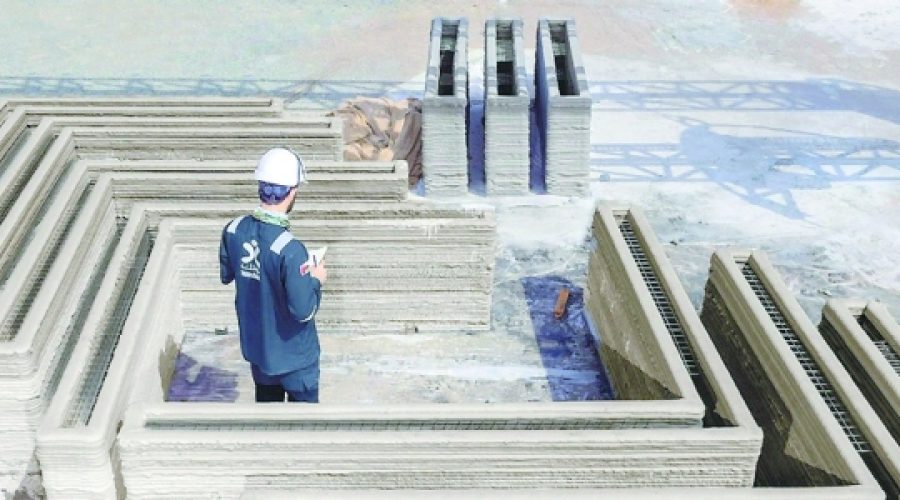
“Our printer has operated for three years under harsh summer heat and winter rain, with significantly fewer maintenance problems than imported machines,” Al Mandhari reported. Innotech has delivered over 14 3D-printed structures, including prayer rooms, public toilets, and pilot buildings for Petroleum Development Oman (PDO). Larger projects such as mosques, schools, and commercial buildings are now underway.
While costs remain slightly higher than traditional construction, Al Mandhari remains optimistic. “Five years ago, 3D printing was science fiction. With ongoing R&D and the use of local materials like LC3, I believe it will soon rival conventional construction,” he said.
Collectively, these academic and entrepreneurial efforts demonstrate that 3D printing in Oman is moving beyond experimentation, establishing a foundation for a more sustainable, automated, and locally grounded construction sector.
Special Analysis by Omanet | Navigate Oman’s Market
Oman’s strategic focus on localising 3D concrete printing using indigenous materials like clays and limestone positions the construction sector as a front-runner in sustainable innovation aligned with Vision 2040. For businesses and investors, this creates a prime opportunity to capitalize on lower-cost, eco-friendly building technologies and to support emerging local tech ventures that reduce dependency on imports. Smart entrepreneurs should consider partnerships in R&D and manufacturing of tailored 3D printing solutions, as the sector is poised to grow rapidly and disrupt traditional construction methods.