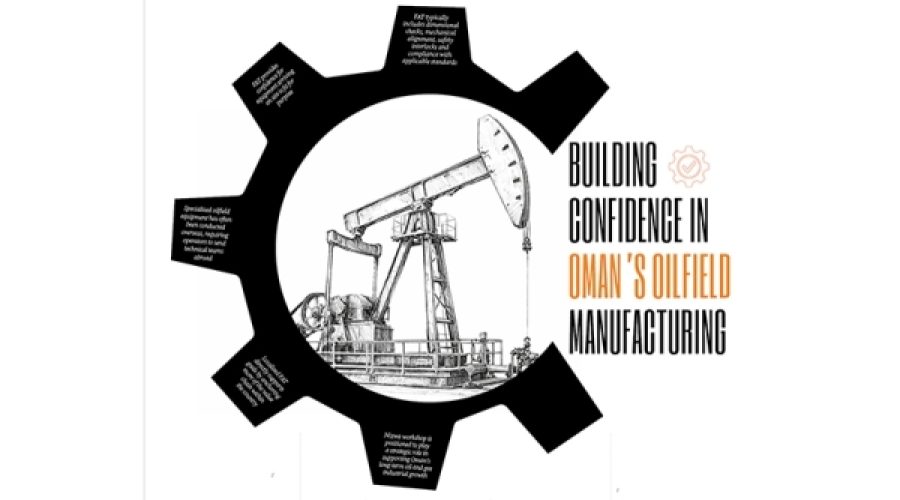
Building Confidence in Oman’s Oilfield Manufacturing: What It Means for Investors and Business Growth
MUSCAT, FEB 23 — As Oman advances its ambitions under Oman Vision 2040, the focus is increasingly shifting from mere production to how industrial capabilities are developed, verified, and sustained within the country. A key process gaining strategic importance in the upstream oil and gas value chain is the Factory Acceptance Test (FAT) — a thorough pre-delivery evaluation that ensures equipment performs precisely as intended before deployment in the field.
A recent FAT conducted on an oil beam pumping unit in Nizwa highlights how this process is evolving beyond a technical checkpoint to become a catalyst for localisation, in-country value (ICV) enhancement, and the strengthening of Oman’s manufacturing ecosystem.
Understanding Factory Acceptance Testing (FAT)
FAT is a methodical and documented process performed at the manufacturer’s site to verify that equipment meets all contractual, operational, and safety standards. For oilfield equipment such as beam pumping units, FAT involves checks of dimensions, mechanical alignment, load testing, functional operation, safety interlocks, and adherence to relevant standards.
The primary goal is to detect and resolve any issues before the equipment is shipped and installed. In upstream oil operations, where downtime is costly and logistics complex, this early verification significantly mitigates technical risks.
Endra Satya Prihandito, General Manager of Bukaka International LLC, explained to the Observer that FAT is crucial in ensuring reliability and efficiency. “Factory Acceptance Testing ensures equipment is fully tested for performance, safety, and integrity before reaching the field, reducing operational risk and unplanned downtime,” he said.
Ensuring Reliability Before Deployment
For oil producers in Oman’s upstream sector, FAT provides assurance that on-site equipment is fit for purpose. Beam pumping units, essential for artificial lift operations, must run continuously under challenging conditions. Failures can result in production losses, higher maintenance costs, and safety risks.
Conducting FAT at the workshop allows operators to witness performance validation, verify documentation, and approve compliance prior to acceptance. Prihandito added that a successful FAT also signals the readiness of the facility to support Oman’s upstream sector by demonstrating disciplined quality standards and the capacity to deliver dependable equipment across the Sultanate.
Local Testing Drives Local Value
Traditionally, FAT for specialised oilfield equipment has often been performed overseas, requiring Omani operators to send technical teams abroad or depend on third-party inspections. Bringing FAT processes in-country transforms this dynamic.
Local FAT shortens supply chains, reduces lead times, and lowers costs related to international logistics and travel. More importantly, it fosters the transfer of technical knowledge within Oman. Engineers, technicians, and inspectors gain hands-on experience with global testing practices, enhancing local expertise that remains in the Sultanate.
“Local FAT strengthens Oman’s industrial capability by cultivating technical skills and developing the local workforce,” Prihandito noted. “It improves responsiveness and reduces dependence on overseas facilities.”
This approach aligns with Oman’s ICV goals, which emphasize local content, skills development, and domestic industrial engagement. Each locally conducted FAT retains economic value through employment, services, and knowledge transfer.
From Assembly Toward Manufacturing
The Nizwa workshop currently specialises in assembly, testing, and servicing of oilfield equipment, but its trajectory is clearly towards broader manufacturing capabilities. The company is pursuing a phased development strategy to achieve this.
Central to this vision is a commitment to internationally recognised certifications such as API Q1 for quality management systems and API 11E for pumping units — benchmarks that enable locally produced equipment to meet global operator standards.
Simultaneously, the company is working toward “Made in Oman” certification, strengthening alignment with national industrial policies and showcasing confidence in the quality of domestic production.
“Expanding local assembly and testing creates a practical pathway toward full-scale manufacturing by gradually building systems, expertise, and quality standards,” said Prihandito. “With planned API certifications and pursuit of ‘Made in Oman’ status, our Nizwa workshop is strategically positioned to support Oman’s long-term oil and gas industrial development.”
Supporting Oman Vision 2040
Oman Vision 2040 aims to diversify the economy, deepen industrial capacity, and reduce import dependency. Localised FAT directly advances these objectives by embedding more value chain stages within the country.
Instead of importing fully assembled and tested equipment, Oman increasingly relies on assets assembled, tested, and eventually manufactured locally. This bolsters supply security, enhances resilience, and ensures quicker operational responses in the upstream sector.
For policymakers and operators, FAT is no longer merely a quality assurance step—it is a foundational element for industrial maturity, bridging assembly and manufacturing as well as policy ambitions and operational realities.
As Oman continues investing in energy infrastructure and industrial development, processes like Factory Acceptance Testing will quietly but decisively shape the journey toward a more self-reliant, value-driven oil and gas sector — firmly grounded in Omani expertise, standards, and territory.
Special Analysis by Omanet | Navigate Oman’s Market
The rise of local Factory Acceptance Testing (FAT) in Oman’s oil and gas sector is a game-changer for industrial capability and economic diversification under Oman Vision 2040. For businesses, this means reduced operational risks, shorter supply chains, and enhanced local value creation through skill development and technical know-how. Smart investors and entrepreneurs should focus on opportunities in upstream equipment manufacturing and quality certification, as Oman positions itself to capture more of the upstream value chain domestically, boosting resilience and sustainable growth.