Impact of War on Aviation: What Investors and Business Owners Need to Know About Grounded Airlines
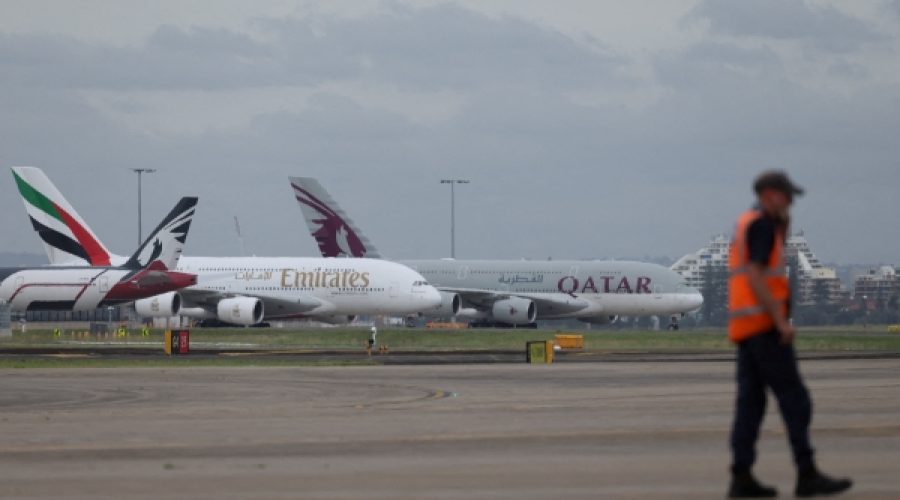
Four decades ago, amid a different Gulf conflict, Dubai’s rulers launched Emirates, an airline that would defy expectations to become one of the world’s largest and most profitable carriers. Today, Emirates and other regional airlines are confronting their most significant challenge since the COVID-19 pandemic due to the ongoing war in Iran.
This conflict has forced airlines in the region to cancel tens of thousands of flights, disrupting the travel plans of millions, many of whom were connecting to other destinations. The critical issues now revolve around how effectively Emirates and its regional counterparts are handling the crisis and the timeline for recovery.
Mike Malik, chief industry officer at aviation data firm Cirium, highlighted the importance of Gulf airline hubs, stating, “These hubs have become indispensable for connecting passengers, but when such disruptions occur, the entire system breaks down.”
The success of the Gulf’s three major airlines—Emirates, Qatar Airways, and Etihad Airways—has been closely linked to their geographic advantage. Positioned in Dubai, Doha, and Abu Dhabi, these hubs lie within convenient flying distance for a large portion of the world’s population, making them ideal for long-haul travel such as New York to New Delhi or London to Sydney. Additionally, backed by strong government support and led by experienced global executives, these airlines have thrived where others in the region have not.
According to Cirium, these carriers dominate routes between Europe and Asia, transporting about one-third of passengers from Europe to Asia and half from Europe to Australia and the Southern Pacific. Overall, the International Air Transport Association reported that 227 million passengers flew through the region last year.
However, the ongoing war has severely crippled air traffic. Since February 28, more than 52,000 flights to and from the Middle East—over half of all planned regional flights—have been canceled, affecting an estimated 6 million passengers.
The financial impact is significant. Middle Eastern airlines are facing operational challenges due to displaced crews and aircraft, while regional tourism has nearly halted. John Strickland, an aviation consultant, emphasized the ongoing financial pressures: “Costs such as aircraft, staff, maintenance, and administrative expenses continue despite the disruptions.”
Tourism Economics estimates that lost tourist spending could range from $34 billion to $56 billion this year, depending largely on the war’s duration and its deterrent effect on travelers. Given current conditions, the higher end of this range is expected. The repercussions also extend globally to countries reliant on Persian Gulf connections, including India and Australia. Brendan Sobie, an aviation analyst, noted, “Hundreds of destinations are significantly impacted to varying degrees.”
An example of the disruption involves San Francisco-based HR and payroll company Deel, which brought nearly 1,500 employees to Dubai for a corporate event in late February. The U.S. attack on Iran the day after the event left about 500 employees stranded. Deel responded quickly, relocating around 100 staff by bus to Oman for flights out of the region. Within a week, nearly all employees were evacuated.
While most affected travelers acknowledged the airlines’ efforts under difficult circumstances, others reported mixed information and limited assistance. American travelers also voiced frustration over perceived inadequate support from the U.S. State Department.
The stakes are high for the Gulf carriers, all government-owned and known for strong profits and customer service. Emirates and Qatar Airways did not respond to interview requests, instead referring to existing traveler guidance statements. Etihad Airways similarly did not reply.
Emirates, established in 1985 during the Iraq-Iran war, was the first of the Gulf airlines to achieve global prominence, long before Dubai became a financial hub of skyscrapers. Today, Gulf airlines boast some of the highest profit margins in the industry, earning approximately $29 per passenger last year, compared with just under $11 for European airlines and $10 for North American carriers, per the International Air Transport Association.
Tony Stanton, CEO of Strategic Air consultancy, noted, “The real reputational test for premium brands is not the occurrence of disruption but maintaining confidence, calm, and control during it.”
Despite the current crisis, experts anticipate a swift recovery once the conflict subsides, noting that air travel typically rebounds quickly after incidents such as crashes, terrorist attacks, or pandemics. Eddy Pieniazek of Ishka consulting pointed out, “Passengers tend to have short memories, especially when bargains are available.”
Financial reserves held by Emirates, Etihad, and Qatar Airways are expected to facilitate recovery, though smaller and budget airlines may face greater challenges.
Meanwhile, airlines outside the region like British Airways, Lufthansa, Qantas, and Turkish Airlines are reportedly seeing increased demand as travelers seek alternative routes. Lufthansa recently announced plans to add flights, particularly to Asia and Africa, including limited service from Germany to Singapore, Cape Town, and Riyadh, Saudi Arabia.
However, expanding capacity remains difficult due to limited availability of planes and crew, and uncertainty around the war’s duration complicates travel forecasting.
Despite recent events, Joe Kauffman, president and CFO of Deel, remains optimistic about Dubai as a corporate destination, citing the city’s amenities and global accessibility. “I really think that Dubai will continue to be a good place for us to be,” he said.
This article originally appeared in The New York Times.
Special Analysis by Omanet | Navigate Oman’s Market
The ongoing conflict in the Gulf has severely disrupted major Persian Gulf airlines, including Emirates, Qatar Airways, and Etihad, highlighting the region’s vulnerability to geopolitical risks despite strong financial reserves and strategic geographic positioning. For businesses in Oman, this disruption presents an opportunity to strengthen alternative transit routes and boost local aviation and tourism infrastructure to capture redirected traffic. Smart investors should consider the resilience of premium carriers and the potential growth for smaller regional airlines or complementary travel services as the industry recalibrates post-crisis.