Asian Shares Dip Ahead of US Jobs Data: What Investors in Oman Should Watch for Market Impact
Asian shares declined further on Thursday as investors rotated away from chipmakers following a strong quarterly performance. Meanwhile, currency and bond markets remained cautious ahead of US jobs data, which could provide key insights into potential interest rate hikes.
Oil prices dropped to four-month lows, with Brent crude falling 1% to $70.88 per barrel. This decline came after US President Donald Trump reported positive progress in talks with Iran in Qatar and noted an increase in oil tanker traffic through the Strait of Hormuz.
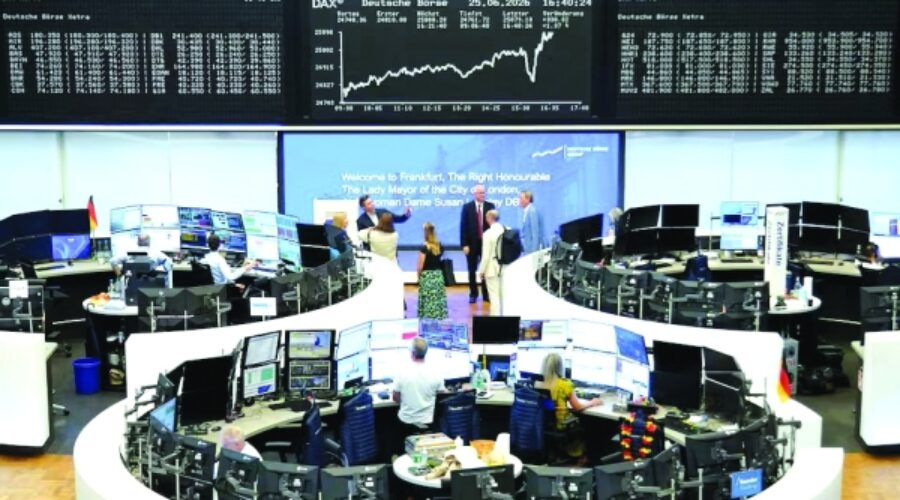
European stock markets are expected to open stable, with futures showing little change. Wall Street futures edged up 0.2% following a selloff in semiconductor stocks overnight. However, shares in Meta Platforms surged nearly 9% amid reports that the company is developing a cloud business to market excess AI computing capacity.
The MSCI Asia-Pacific index, excluding Japan, fell 1.2%, while Japan’s Nikkei declined 1.4%. Hong Kong’s Hang Seng index bucked the trend with a 0.9% gain. South Korea’s KOSPI plunged 4.8%, continuing Wednesday’s 2% drop, despite a remarkable 68% surge in the second quarter driven by soaring AI-related demand for memory chips. SK Hynix and Samsung shares dropped 8.5% and 7.2%, respectively.
Fabien Yip, market analyst at IG, attributed the semiconductor slide to a “hangover from Wall Street,” driven primarily by profit-taking. He also pointed to Apple’s reported engagement with restricted Chinese memory chip manufacturers for devices targeting the Chinese market, introducing pricing pressure on established Korean and Japanese suppliers.
Investor focus is firmly on the US non-farm payrolls report due Thursday, especially with Friday observing the Independence Day holiday. Economists surveyed by Reuters anticipate a job increase of 110,000 for June, though estimates vary widely between 25,000 and 200,000, indicating a high potential for surprises. The unemployment rate is expected to remain steady at 4.3%.
Chris Weston, head of research at Pepperstone, explained that equity investors prefer a “Goldilocks” scenario: solid job creation paired with stable unemployment. “Anything that avoids a significant rise in the likelihood of near-term rate hikes will likely be welcomed by equity bulls,” he said.
At the Sintra Forum, Federal Reserve Chair Kevin Warsh noted that inflation risks have recently diminished but only provided brief relief to Treasury markets. He reaffirmed his commitment to the 2% inflation target, warning that he would “disappoint” those expecting loose monetary policy. Markets currently estimate about an 80% probability of a rate hike in September.
In anticipation of potentially strong jobs data, Treasury yields have risen. On Thursday, the US 2-year yield climbed 2 basis points to 4.1806%, gaining 9 basis points over the week, while the 10-year yield also rose 2 basis points to 4.4911%, up 12 basis points for the week.
Higher Treasury yields supported the US dollar, which remained steady against the euro at $1.1385. The euro had slipped 0.4% overnight after European Central Bank President Christine Lagarde remarked that inflation and growth risks were becoming more balanced. The dollar eased slightly by 0.1% to 162.39 yen, after reaching a 40-year high of 162.84 yen on Wednesday.
— رویترز
تحلیل ویژه از عمانت | بازار عمان را کشف کنید
The recent volatility in Asian chip stocks and the dip in oil prices signal potential short-term pressures on Oman’s tech and energy sectors. For businesses, this means heightened market uncertainty and the need for cautious risk management amid global shifts in demand and pricing. Smart investors should monitor U.S. economic data and geopolitical developments closely, as these could influence interest rates and oil markets, creating both risks and opportunities for strategic positioning in Oman’s growth sectors.