Oil Shock Deepens: What Investors and Businesses in Oman Need to Know Now
When searching for the price of oil, two commonly cited figures often appear: one for the United States and another for Europe. These prices fluctuate continuously on electronic markets, reflecting the current state of the global energy landscape. While the ongoing conflict involving Iran has driven energy costs higher, the situation is not as severe as it was four years ago, following Russia’s invasion of Ukraine.
However, procuring an actual tanker full of oil on short notice has become extraordinarily expensive.
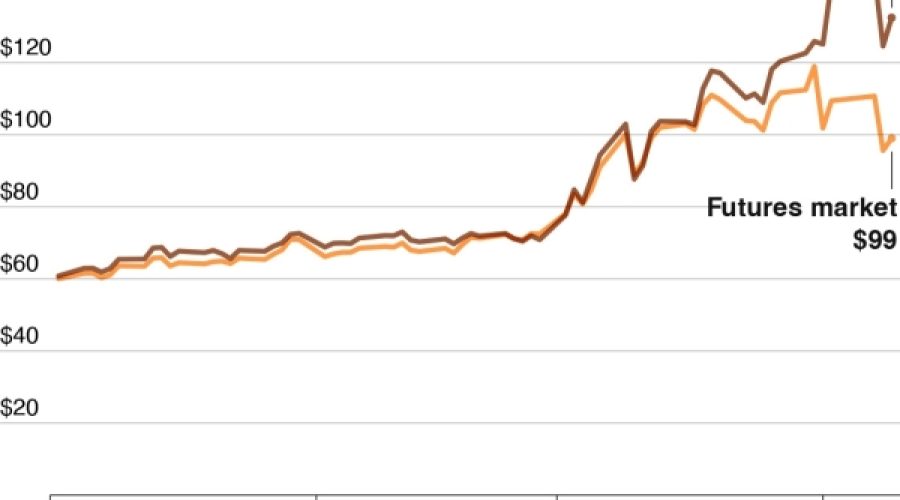
On Tuesday, just before President Donald Trump announced a ceasefire agreement between the United States and Iran, the widely referenced price of Brent crude oil — the European benchmark — stood at approximately $109 per barrel. This figure, though high, remains below the peak prices seen in 2022 when Brent briefly surpassed $130 per barrel (unadjusted for inflation).
In contrast, the spot market price for physical oil — reflecting the cost of liquid crude oil available for immediate shipment — soared to nearly $145 per barrel. This was a record high and more than double the price before the U.S. and Israel launched attacks on Iran on February 28, according to Argus Media, a commodity price tracking firm.
The disparity between these two prices arises from their nature: the commonly cited Brent price is a futures price, a financial instrument representing traders’ expectations of oil’s value in one to two months, akin to a stock price. The second, the spot price, is tied to the delivery of actual crude oil shipments that refineries convert into gasoline, diesel, and jet fuel.
While futures and spot prices typically differ, the current gap has widened unusually in recent weeks. Industry experts say this discrepancy means futures prices no longer fully capture the severe supply disruptions currently affecting global oil markets.
“The futures market is not representing the on-the-ground and on-the-water reality of oil at all,” remarked Vikas Dwivedi, global energy strategist at Macquarie Group. “It’s quite broken.”
Chevron CEO Mike Wirth echoed these concerns during the recent CERAWeek energy conference in Houston. “Physical prices and physical supplies would reflect a tighter market than I think the forward curve reflects,” he stated, referring to futures pricing.
Historically, futures and spot prices tend to diverge during major market disruptions such as the COVID-19 pandemic and Russia’s invasion of Ukraine, when geopolitical events amplify the contrast between current and future oil values. However, the current price gap is unparalleled in the past two decades, with analysts struggling to explain its full extent.
“It is a mystery,” said Dwivedi.
The war involving Iran has profoundly disrupted oil markets. Estimates suggest that over 10% of global oil supply has been shut off due to shipping risks through the Strait of Hormuz, a critical but narrow shipping passage between Iran and the Arabian Peninsula.
This has caused worldwide price surges and fuel shortages in some Asian countries heavily reliant on Persian Gulf supplies. Gas stations in Vietnam and Thailand have turned customers away due to lack of fuel; Sri Lanka has declared every Wednesday a public holiday; and remote work mandates or encouragement have been implemented elsewhere to reduce fuel demand.
Although the recent two-week ceasefire announced by President Trump temporarily pushed oil prices down, the underlying situation remains precarious. Shipping companies continue to avoid the Strait of Hormuz, leaving a significant portion of the world’s oil trapped in the Persian Gulf.
“The physical price just tells you how tight everything is right now,” said Jason Gabelman, an energy analyst at TD Cowen.
This report originally appeared in The New York Times.
Special Analysis by Omanet | Navigate Oman’s Market
The widening gap between spot and futures oil prices amid the Iran conflict signals a severe supply crunch that is not fully reflected in financial markets, posing risks of sustained volatility for Oman’s energy-dependent economy. For businesses, this means heightened uncertainty in fuel costs and supply chain disruptions, while smart investors should prioritize ventures that enhance supply security and alternative energy solutions to capitalize on the tightening market. Entrepreneurs and policymakers must proactively adapt to a new reality of constrained physical oil availability despite moderate futures pricing, ensuring resilience in Oman’s strategic energy sector.