Oil Price Surge Amid Iran Conflict: What Investors and Businesses in Oman Should Expect
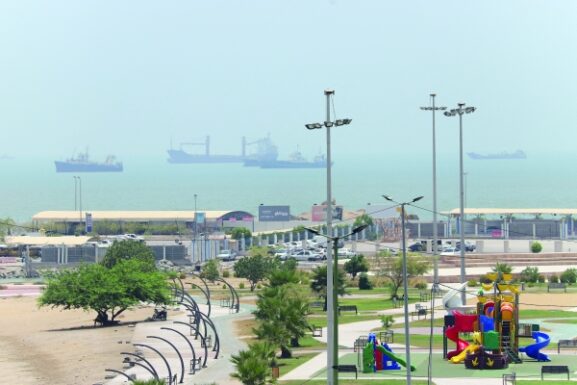
Hong Kong – Oil prices surged while stock futures declined on Monday amid escalating tensions in the Middle East, which severely disrupted shipping activities in and out of the Gulf. Despite these challenges, traders remained hopeful for a resolution, and Asia’s equity markets moved closer to record highs.
Brent crude futures climbed approximately 6% to reach $95.36 per barrel. Meanwhile, S&P 500 futures dropped by about 0.6%, and European futures fell 1.2%. Nonetheless, equity indices in Seoul, Taipei, and Tokyo showed resilience, with Taiwan’s market hitting a record high and the others closely following suit.
On Friday, crude prices plummeted as U.S. and European stocks rallied after Iran indicated it would allow ships to transit the vital waterway—through which around 20% of global oil and LNG typically passes—citing a ceasefire between Israel and Lebanon.
Former U.S. President Donald Trump told AFP that “we’re very close to having a deal,” and that there were “no sticking points at all” remaining with Tehran. However, Iran promptly rejected this, stating their enriched uranium stockpile would not be relocated “anywhere.”
The U.S. benchmark West Texas Intermediate (WTI) fell over 11%, while Brent crude declined by 9%.
On Monday, both oil contracts rebounded sharply ahead of the scheduled end of a two-week ceasefire. The surge was driven by a continuing U.S. blockade and the recent seizure of an Iranian ship by an American destroyer, which had attempted to evade the blockade. Iran warned it would respond to such actions.
The blockade of Iranian ports remains a major impasse in U.S.-Iran negotiations. Iran’s state broadcaster IRIB cited sources confirming that Tehran currently has no plans to participate in the next round of talks in Pakistan. Earlier reports from Fars and Tasnim news agencies described the negotiating environment as “not very positive,” emphasizing that lifting the U.S. blockade is a condition for renewed discussions.
At one point on Monday, WTI futures gained over 7% while Brent increased more than 6%.
To date, only one 21-hour meeting in Islamabad took place on April 11, ending without resolution, though preparatory efforts for further negotiations have continued.
Trump expressed optimism over the weekend, stating on social media, “We’re offering a very fair and reasonable DEAL, and I hope they take it,” while also renewing threats against Iran’s infrastructure should talks fail.
In response, Iran’s Revolutionary Guards declared that any unauthorized passage through the Strait of Hormuz “will be considered cooperation with the enemy,” warning that offending vessels would be targeted. Foreign Ministry spokesman Esmaeil Baqaei denounced the U.S. blockade as “a violation” of the ceasefire.
Despite the ongoing tensions, global equities advanced, buoyed by record closes for the S&P 500 and Nasdaq in New York. Markets in Tokyo, Seoul, and Taipei led gains, fueled by a resurgence in tech stocks reminiscent of the rally prior to the conflict’s outbreak on February 28. Other Asian markets including Hong Kong, Shanghai, Wellington, and Manila also recorded notable gains.
The U.S. dollar, which served as a safe haven during the crisis and dropped significantly on Friday, strengthened against major currencies on Monday.
Chris Weston, Chief Market Analyst at Pepperstone, noted that traders were evaluating “whether the ceasefire can be salvaged through this week’s diplomatic talks,” while reassessing the likelihood of military escalation. He added that Trump’s weekend comments “raised the prospect of military re-escalation,” but many viewed these as strategic hawkish signals ahead of negotiations rather than imminent actions.
Weston emphasized that the path to a formal U.S.-Iran agreement “is unlikely to be linear and remains vulnerable to sudden developments,” leaving investors prepared for sentiment shifts. He warned that without a comprehensive resolution to Iran’s nuclear program, the ceasefire remains fragile.
Special Analysis by Omanet | Navigate Oman’s Market
The renewed Middle East tensions and the resulting volatility in oil prices underscore Oman’s strategic vulnerability and opportunity as a key Gulf player. Businesses must brace for supply chain disruptions and price swings, while savvy investors should consider diversifying into sectors less exposed to geopolitical risks. Entrepreneurs can explore innovative logistics and energy solutions to capitalize on shifting market dynamics amid ongoing uncertainty.