Korea–India Summit: What the Stronger Economic Partnership Means for Business Opportunities and Investment Growth
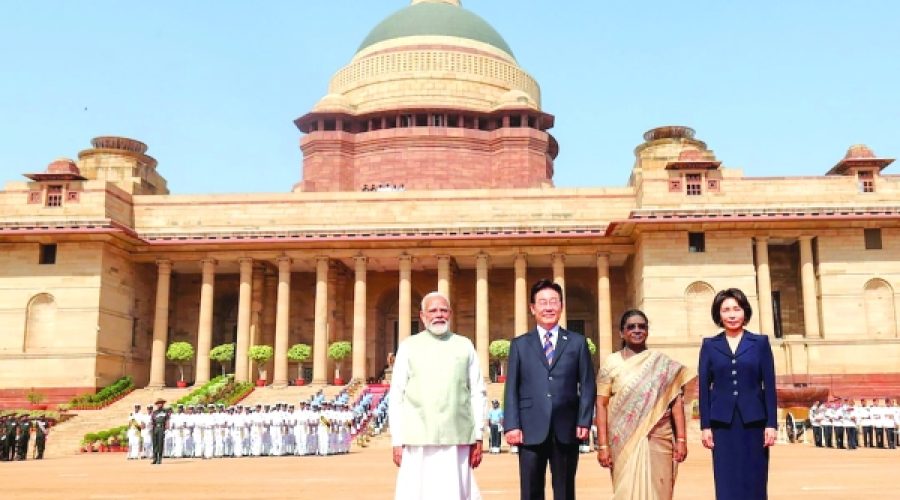
SEOUL: South Korean President Lee Jae Myung’s visit to India is set to invigorate bilateral economic relations, with both nations aiming to unlock untapped cooperation areas and pursue a more ambitious trajectory for trade and investment.
During his meeting with Indian Prime Minister Narendra Modi in New Delhi, President Lee is expected to focus on strengthening collaboration in shipbuilding, as well as emerging sectors such as finance, artificial intelligence, and defence. This visit—the first by a South Korean president to India in eight years—reflects a mutual desire to elevate economic engagement to align with broader strategic goals.
Ahead of the summit, Lee underscored the current “low” level of economic cooperation between the two countries. Both sides are now working to upgrade their Comprehensive Economic Partnership Agreement (CEPA), aiming to boost bilateral trade to $50 billion by 2030, up from $25.7 billion recorded last year.
This initiative arises amid shifting global economic conditions, prompting both countries to diversify supply chains and reinforce trusted partnerships. Lee emphasized that instability linked to the Iran conflict highlights the necessity of closer coordination, positioning India as a key partner not only as a consumer market but also as an expanding production and supply chain hub.
Energy cooperation is becoming a practical pillar of this evolving partnership. South Korea’s recent request for increased naphtha supplies from India illustrates efforts to mitigate potential disruptions caused by tensions in the Middle East. Currently, India accounts for about 8 percent of South Korea’s naphtha imports, indicating potential for growth that could also help balance trade flows.
Trade dynamics are an important factor shaping future relations. South Korea posted a $12.8 billion trade surplus last year, with exports totaling $19.2 billion and imports $6.4 billion. Expanding imports from India, particularly energy-related products, is viewed as a way to address this imbalance while fostering broader economic cooperation.
Sectoral alignment offers further opportunities, with shipbuilding standing out as a complementary field that combines India’s focus on job creation with South Korea’s industrial expertise. Additionally, rising interest in Korean consumer goods and culture could drive growth in the food and retail sectors.
As President Lee meets with business leaders during his visit, the focus will be on transforming policy intentions into tangible results. This summit marks a significant step toward forging a more balanced, diversified, and forward-looking economic partnership between the two nations.
Special Analysis by Omanet | Navigate Oman’s Market
South Korea’s renewed focus on deepening economic ties with India highlights a strategic pivot towards diversifying supply chains and enhancing cooperation in high-growth sectors like shipbuilding, AI, and energy. For businesses in Oman, this signals opportunities to integrate into expanding regional supply networks and leverage shifting trade flows, especially in energy and manufacturing. Smart investors should watch evolving partnerships closely and consider entering markets or forming alliances that benefit from this geopolitical realignment and trade balance efforts.