2026 Oman Bid Round: Unlocking Diverse Onshore Investment Opportunities for Business Growth
The Ministry of Energy and Minerals of Oman has announced the offering of five upstream oil and gas blocks for local and international investment under the 2026 Oman Licensing Round. These blocks cover a combined area of approximately 48,000 square kilometers and include Onshore Blocks 12 (Non-Associated Gas), 16, 42, 45, and 55. The Ministry described these blocks as a “compelling and diverse onshore investment portfolio” that spans multiple proven petroleum systems and geological settings, offering a balanced mix of exploration opportunities from near-field appraisal upside to frontier potential.
Four of the licenses come from the strategic partitioning of two legacy blocks into a more dynamic dual-block configuration, intended to stimulate exploration and maximize resource recovery while maintaining the overall exploration value. Specifically, legacy Block 12 was split into Blocks 12 and 16, while legacy Block 42 was divided into Blocks 42 and 45.
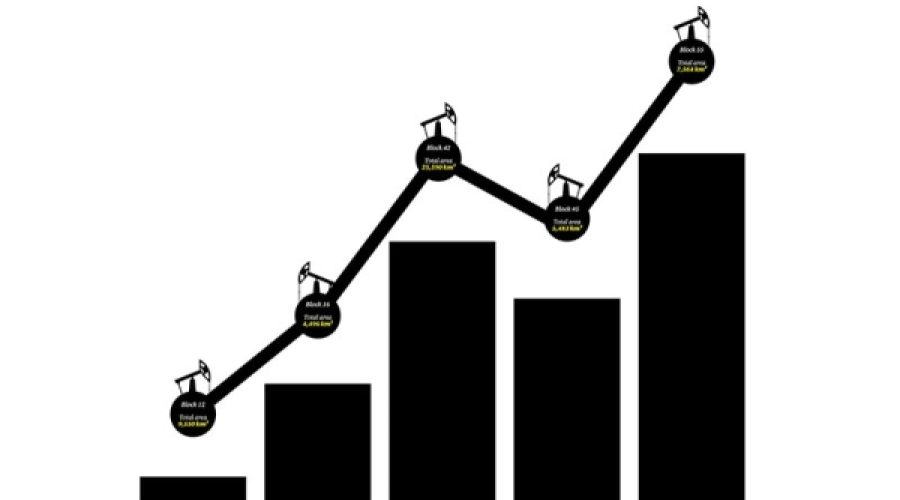
Block 12: Originally around 9,550 km², Block 12 has been a cornerstone of central Oman’s onshore exploration. Positioned near key hydrocarbon provinces and infrastructure, the block was partitioned into a new Block 12 (approx. 5,050 km²) and Block 16 to better focus exploration efforts. Despite recent drilling by a consortium led by TotalEnergies and PTTEP not finding commercial hydrocarbons, the activities enriched geological knowledge, maintaining significant exploration potential.
Block 16: Covering approximately 4,496 km², Block 16 lies strategically between the Greater Barik area and Block 6. It benefits from excellent logistical access and proximity to key energy infrastructure, including major gas developments in neighboring blocks. Geological studies indicate it remains underexplored at depth, with good prospects particularly for deeper gas formations.
Block 42: Spanning about 25,590 km² in northeastern Oman, Block 42 covers diverse terrain near the Ghaba Salt Basin, a highly productive hydrocarbon zone. The block’s subdivision aims to increase exploration focus and is adjacent to Oxy’s Block 51, where multiple untested prospects suggest resource continuity.
Block 45: With an area of 5,483 km², Block 45 forms the southern part of the former Block 42. It shares geological similarities with nearby producing regions. Previous exploration by OOCEP/OQEP and Shell, which operated the block until 2025, did not yield commercial discoveries. The block was recently returned to the government and remains promising due to its proximity to active fields and nearby untested prospects.
Block 55: Covering roughly 7,564 km² in Al Wusta Governorate, Block 55 lies near some of Oman’s most productive oil and gas areas. Although exploration has been limited, especially compared to adjacent blocks, its western side shows promise given its closeness to producing fields such as Mukhaizna. The block also benefits from nearby infrastructure, including pipelines and storage facilities, potentially reducing future development costs.
These blocks represent significant opportunities for investment in Oman’s onshore oil and gas sector, combining proven hydrocarbon systems, infrastructure advantages, and exploration upside across diverse geological settings.
Special Analysis by Omanet | Navigate Oman’s Market
The 2026 Oman Licensing Round’s division of legacy blocks into smaller, more focused concessions creates strategic opportunities for balanced exploration and resource maximization, particularly in well-infrastructured areas close to existing developments. For businesses and investors, this signals a calculated risk-reward environment, where deeper and underexplored prospects in Blocks 16, 42, 45, and 55 hold significant upside, but require advanced geological insights and patient capital. Smart players should prioritize leveraging enhanced seismic data and infrastructure proximity to accelerate discovery monetization and optimize entry into Oman’s evolving hydrocarbon landscape.