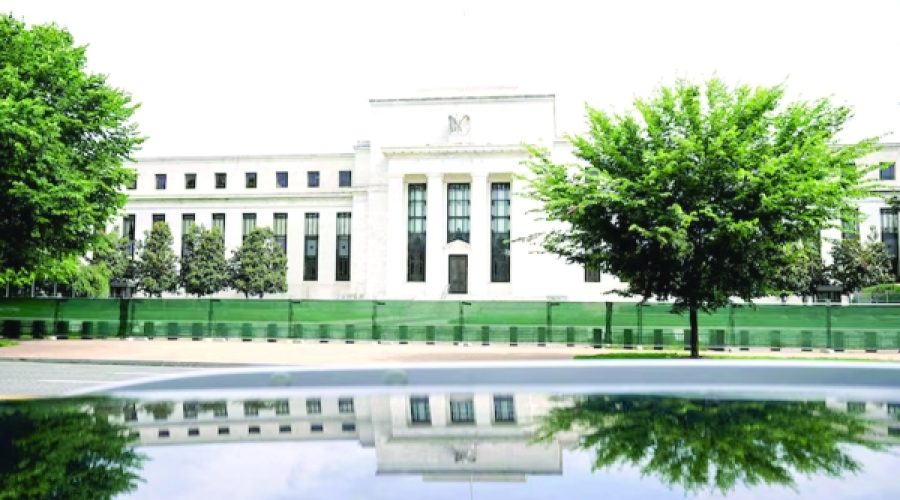
Fed Cuts Rates Amid Division: Implications for Investors and Businesses in Oman
WASHINGTON: In a split decision, the Federal Reserve announced a cut in interest rates on Wednesday, but indicated that further reductions are unlikely in the short term as it seeks clarity on a softening job market, inflation that remains "somewhat elevated," and an economy projected to gain momentum next year.
Following the conclusion of the US central bank’s final two-day meeting of 2025, new projections revealed a median expectation for just one additional quarter-percentage-point cut next year, consistent with forecasts made in September. However, a broad range of estimates illustrated significant disagreement among policymakers regarding the trajectory of monetary policy for 2026 and beyond, particularly in light of changes stemming from President Donald Trump’s policies and the rapid growth of artificial intelligence investments.
The Federal Open Market Committee (FOMC) stated, "In considering the extent and timing of additional adjustments to the target range for the federal funds rate, the Committee will carefully assess incoming data." This statement included language typically associated with a pause, diverging from market predictions of two rate cuts in 2026.
Policymakers’ revised estimates—limited by incomplete data resulting from a six-week government shutdown—project inflation to ease to approximately 2.4% by the end of next year, with economic growth expected to accelerate to 2.3% and unemployment remaining steady at 4.4%. This eases concerns regarding stagflation.
As the committee approaches a leadership transition—with Trump anticipated to nominate a successor to Fed Chair Jerome Powell in the upcoming weeks—divisions remain evident. During a press conference, Powell remarked, "Having reduced our policy rate by 75 basis points since September and 175 basis points since last September, the fed funds rate is now within a broad range of estimates of its neutral value. We are well positioned to wait to see how the economy evolves." He added that no decision has been made regarding future policy changes before the late-January meeting.
The major US stock indices experienced a rise, the dollar weakened, and Treasury yields decreased.
While the 25-basis-point cut was largely anticipated, the updated "dot plot" revealed differing opinions, with six policymakers advocating for no rate change at this meeting. The decision to lower the benchmark rate to a range of 3.50% to 3.75% faced three dissenting votes: Chicago Fed President Austan Goolsbee and Kansas City Fed President Jeffrey Schmid supported maintaining the current rate, while Fed Governor Stephen Miran continued to push for a larger half-point cut.
The future direction of policy—especially as the US midterm election year approaches, with Trump calling for aggressive rate reductions—will rely on forthcoming data, which has been delayed following the recent government shutdown. Official job and inflation statistics for November are expected next week.
The revised projections indicated that six policymakers preferred no cut this year, while seven anticipated no further reductions in 2026. The median outlook suggests one additional quarter-point cut in 2027 as inflation gradually returns to the 2% target.
Some analysts speculate that the Fed may remain unchanged for the time being due to the lack of consensus, slow data flow, and the impending leadership change; however, softness in labor indicators could prompt a reconsideration of a 25-basis-point cut in January. — Reuters
Special Analysis by Omanet | Navigate Oman’s Market
The Federal Reserve’s recent interest rate cut signals a cautious approach toward economic recovery, which may influence Oman’s businesses reliant on economic stability in the U.S. Opportunities may arise for strategic investments in sectors like technology and AI, spurred by ongoing shifts in global economic dynamics, while fluctuating borrowing costs pose risks for new ventures. Entrepreneurs and investors should consider monitoring labor market trends and inflation indicators to align their strategies with evolving monetary policies.