EPS Cement Revolutionizes Green Building in Oman: Impact and Opportunities for Investors
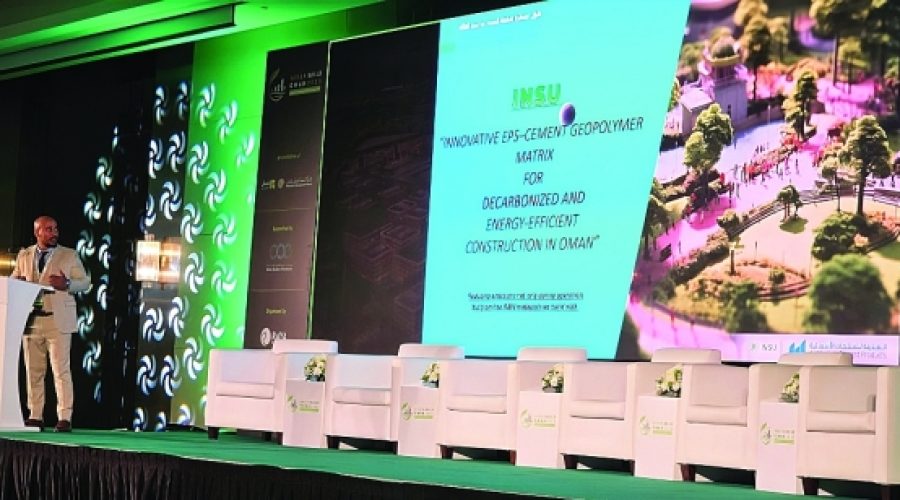
MUSCAT: Oman’s construction sector is facing increasing pressure to comply with stricter energy efficiency targets and lower carbon emissions as sustainability shifts from policy ambition to regulatory implementation. Developers are now tasked with creating buildings that enhance performance throughout their entire lifecycle, rather than merely during operation. During the recent Green Build Oman Summit held in Muscat, expanded polystyrene (EPS)–cement composites were highlighted as a promising solution to meet these evolving demands.
Addressing industry stakeholders, Youssif AbdelAleem, Technical Manager at Al Madina Cement Products, emphasized that the future of construction in Oman depends on materials that integrate energy efficiency, environmental responsibility, and practicality. “We did not choose EPS randomly,” he stated. “We chose it because it meets the four critical demands of today’s market: thermal insulation, sustainability, cost efficiency, and ease of operation.”
AbdelAleem elaborated that EPS-based cementitious and geopolymer matrices rely mainly on entrapped air for insulation, rather than manufactured gases. He noted that air is the most effective and natural insulating material. “The best-selling insulation material in the world is air,” he remarked. “When air is trapped inside EPS, it significantly reduces heat transfer through conduction and convection, which is vital in hot climates like Oman.”
This method has profound implications for decarbonization. Many traditional insulation materials utilize manufactured gases with exceptionally high global warming potential (GWP), often exceeding 1,400. Due to international agreements, such as the Montreal Protocol, these materials are expected to face increasing restrictions. “Most insulation products dependent on manufactured gases will be phased out due to their high GWP,” AbdelAleem cautioned. “In contrast, EPS systems can have a GWP as low as 7 to 41, a substantial difference.”
Beyond carbon metrics, AbdelAleem stressed the importance of long-term performance in extreme climates. EPS cement composites are resilient to ultraviolet exposure and moisture, unlike gas-based insulation. “EPS does not lose its efficiency over time,” he explained. “If it absorbs water or faces UV exposure, the air is simply replaced, ensuring stable thermal performance throughout the building’s lifespan.”
Breathability was another crucial topic, particularly relevant in Oman’s hot, humid environment. Non-breathable walls and roofs can trap moisture, leading to condensation, mold, and premature aging of buildings. “If your wall is not breathable, a building that is only two years old can appear like it is 20 years old,” AbdelAleem noted. “In this climate, breathability is not a luxury; it’s essential.”
He also highlighted that EPS-based systems address longstanding challenges related to workmanship and complexity in construction. Traditional multi-layer insulation systems often suffer from performance gaps due to joints, detailing errors, and inconsistent application. In contrast, EPS cement blocks, mortars, and plasters can be applied using standard construction practices. “You don’t need special adhesives or complicated layers,” he said. “It is plaster like plaster, mortar like mortar. Any contractor can apply it.”
From an economic perspective, AbdelAleem pointed out that thermal insulation is one of the few building investments that yields a return. Effective insulation lowers cooling loads, reduces electricity costs, and extends the lifespan of air-conditioning systems. “Investing in thermal insulation is unique in that it is the only element in a building that can pay you back over time,” he stated.
Importantly, the discussion also encompassed embodied carbon. With building codes increasingly prioritizing lifecycle assessments, materials must be scrutinized from raw material extraction through manufacturing, construction, and eventual recycling. EPS cement systems, being lightweight, recyclable, and low-energy to produce, present a strong profile within this framework.
Special Analysis by Omanet | Navigate Oman’s Market
Oman’s construction sector is poised for significant transformation as stricter energy efficiency targets reshape industry standards. This shift creates opportunities for businesses that adopt innovative materials like EPS-cement composites, which enhance sustainability and cost efficiency. Investors should consider aligning projects with these emerging technologies to not only comply with regulations but also capitalize on the long-term savings associated with improved energy performance and lifecycle assessment.