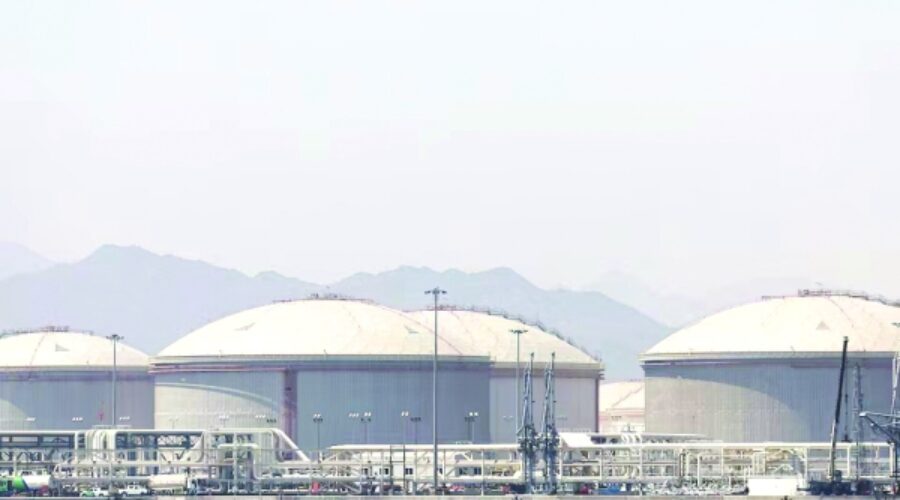
Crude Oil Prices Rise Amid Hormuz Disruptions: What This Means for Your Investments and Business in Oman
SINGAPORE – Oil prices rose by more than 1% on Thursday, recovering some losses as investors closely watched peace talks between the United States and Iran. Support also came from tight supply conditions and ongoing reductions in U.S. oil inventories.
Brent crude futures increased by $1.27, or 1.21%, reaching $106.29 per barrel. Meanwhile, U.S. West Texas Intermediate (WTI) futures climbed $1.29, or 1.31%, to $99.55 a barrel.
Both benchmarks had fallen over 5.6% on Wednesday to their lowest levels in over a week, following President Donald Trump’s announcement that negotiations with Iran were in their final stages. However, Trump also warned of potential further attacks if Tehran did not agree to a peace deal.
“The oil market remains highly sensitive to Iran-related developments, with traders placing significant hope on reports that U.S.-Iran talks are advancing,” noted analysts from ING. They cautioned, “We have been through similar scenarios before, often leading to disappointment,” and predicted Brent prices would average $104 per barrel during this quarter.
Iran, meanwhile, warned against further attacks and announced measures to strengthen its control over the strategically vital Strait of Hormuz. The passage, which is mostly closed, had previously handled oil and liquefied natural gas shipments accounting for around 20% of global consumption.
On Wednesday, Iran established a new “Persian Gulf Strait Authority” and declared a “controlled maritime zone” in the Strait of Hormuz. The strait was effectively closed by Iran in response to U.S. and Israeli strikes that sparked the conflict on February 28. Although most hostilities have ceased following a ceasefire in April, Iran continues to restrict maritime traffic, while the U.S. has imposed a blockade along Iran’s coastline.
Supply disruptions from this key Middle Eastern producing region have forced countries to rapidly draw from commercial and strategic reserves, raising concerns about depletion. The U.S. Energy Information Administration (EIA) reported on Wednesday that the U.S. withdrew nearly 10 million barrels of oil from its Strategic Petroleum Reserve last week, marking the largest single-week drawdown on record.
Additionally, EIA data indicated a sharper-than-expected drop in U.S. crude oil inventories last week, underscoring the effect of supply shortages.
“The ongoing inventory drawdowns will make it difficult for oil prices to stay low,” said Mingyu Gao, chief researcher for energy and chemicals at China Futures. “With the Strait of Hormuz blocked, global refined product and onshore crude stocks are expected to fall to their lowest levels for this time of year in the past five years by late May and June.”
— Reuters
Special Analysis by Omanet | Navigate Oman’s Market
The ongoing tensions and supply disruptions around the Strait of Hormuz, compounded by rapid global oil inventory drawdowns, signal persistent volatility and upward pressure on oil prices. For businesses in Oman, this creates both a risk of increased operational costs and an opportunity to capitalize on higher oil revenues. Smart investors and entrepreneurs should consider positioning themselves in sectors linked to energy logistics, strategic storage, and alternative energy solutions to hedge against instability while leveraging Oman’s strategic location.