Oman’s Hydrogen Strategy: Transforming the Energy-Water-Food Nexus and Unlocking New Business Opportunities
MUSCAT – A recent commentary published by the World Economic Forum highlights that Oman’s emerging green hydrogen industry is being shaped not just by its abundant renewable energy resources, but by an advanced governance model that integrates energy, water, and food security into a unified national strategy.
Co-authored by Rumaitha al Busaidy, Vice President of the Environment Society of Oman, and Akram Azerbayev, Vice President of Business Development at OQ Alternative Energy, the report titled “How Oman is preparing to lead on hydrogen exports” emphasizes that Oman’s extensive experience in managing water scarcity is becoming a strategic advantage as the country positions itself among the world’s leading renewable hydrogen exporters.
The International Energy Agency (IEA) projects Oman to be among the top six global renewable hydrogen exporters by 2030. However, the authors argue that Oman’s key differentiator lies not only in its export volume but in the robust governance framework behind its hydrogen ambitions.
Unlike many nations that treat water as a secondary input in hydrogen production, Oman regards water as a sovereign resource with competing demands from agriculture, municipalities, industry, and the emerging hydrogen sector. Given the country’s limited freshwater resources, relying solely on desalination is insufficient.
The commentary points out that producing one kilogram of hydrogen requires approximately 35 kilograms of purified water, making desalination essential in arid regions. Nevertheless, large-scale desalination raises concerns related to energy consumption, marine ecosystem impacts from brine discharge, and public concerns over water allocation.
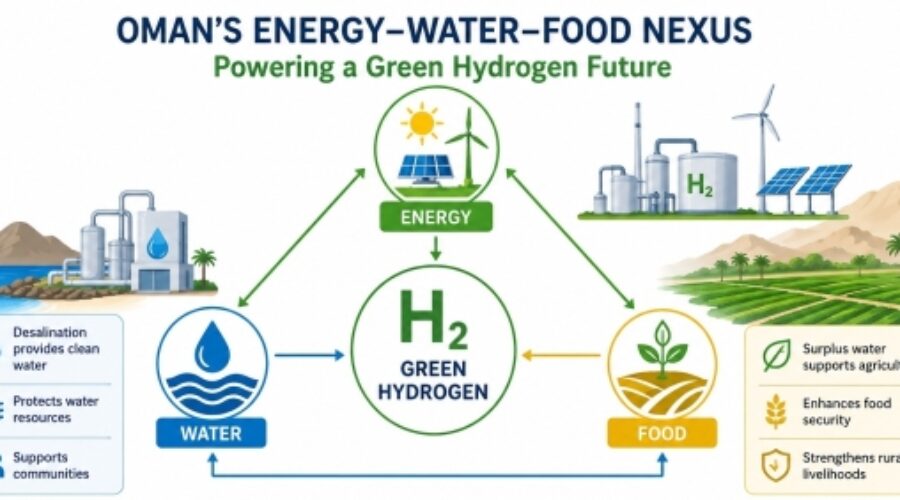
To tackle these challenges, Oman has incorporated an “energy-water-food nexus” into its hydrogen planning framework, anchored in four core policy components:
1. Integrated resource planning across the ministries of energy, water, and agriculture to replace isolated sectoral decision-making with coordinated governance.
2. Inclusion of brine valorization requirements in project designs from the outset, aiming to recover valuable minerals and minimize marine discharge impacts rather than treating brine solely as waste.
3. Mechanisms to allocate surplus desalinated water towards agriculture and community use, thereby enhancing food security and reducing stress on diminishing groundwater reserves.
4. Legally enforceable community water commitments embedded in project approvals, ensuring water access obligations are contractual rather than voluntary.
The authors highlight that these measures are strongly supported by Oman Vision 2040, which aligns economic diversification, water security, and sustainability objectives within a cohesive national framework. This coordinated policy approach fosters investor confidence by developing Oman’s hydrogen sector under a stable and well-integrated governance model.
Significantly, Oman’s strategy differs from many international hydrogen initiatives by treating desalinated water production not as a by-product but as an economic and strategic benefit in its own right. Excess desalinated water produced for electrolysis can support agriculture and lessen dependence on imported food.
The commentary concludes that Oman’s early adoption of integrated resource governance may ultimately prove more valuable than its renewable energy potential alone. As global hydrogen economies expand, countries demonstrating credible water governance, enforceable community commitments, and integrated resource planning will be best positioned to attract sustained investment and public support.
Special Analysis by Omanet | Navigate Oman’s Market
Oman’s pioneering integrated governance model for green hydrogen, which strategically balances energy, water, and food security, positions the country as a global leader beyond just renewable resource abundance. For businesses and investors, this means stable, sustainable growth opportunities rooted in trusted water management, crucial in an arid region where water scarcity poses significant risks. Smart entrepreneurs should consider Oman’s unique approach to resource synergy and legal water commitments as a competitive advantage that enhances resilience and long-term value in the emerging hydrogen economy.