Drive for Secure Enterprise AI in Oman: What It Means for Business Innovation and Investment
MUSCAT, JUNE 29 – A new alliance in the telecom and technology sectors has launched a coordinated initiative to accelerate the deployment of localized, secure artificial intelligence (AI) within Oman’s corporate sector. This move responds to increasing regulatory demands for stringent domestic data isolation across the Gulf region.
The announcement was made at a prominent cloud forum held at the JW Marriott Muscat, which gathered over 100 regional executives to discuss the challenges of integrating enterprise AI. The event was co-hosted by Ooredoo Business and Google Cloud.
As Gulf Cooperation Council (GCC) economies rapidly adopt large language models under digital transformation frameworks like Oman Vision 2040, local businesses face significant challenges. Strict compliance and data residency laws prohibit sensitive data from being transferred across borders, complicating the use of global, consumer-focused generative AI tools. Diaa Eldin Ali, Senior Data and AI Customer Engineer at Google Cloud, emphasized during his keynote that “true market differentiation now depends not only on the AI model’s intelligence but also on the robustness and security of its computational infrastructure.“
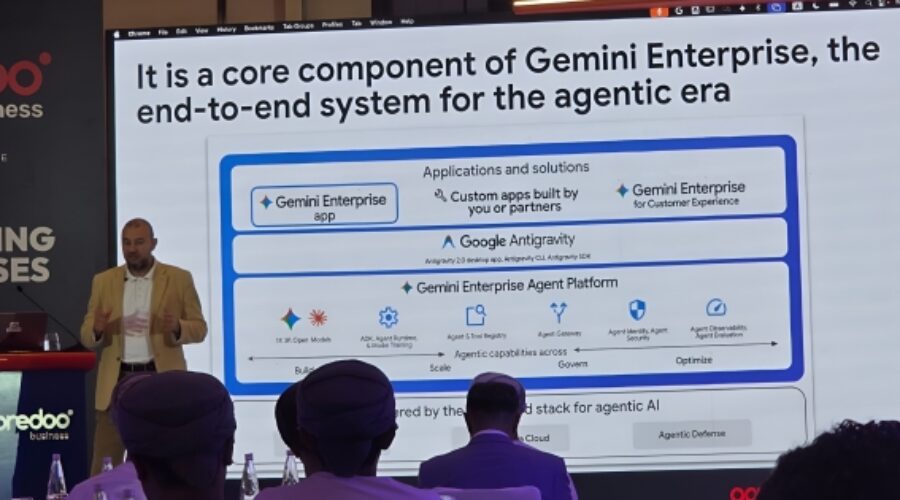
Ali outlined a multi-layered architecture based on the Gemini enterprise ecosystem, which distinctly separates high-speed processing for lighter models from the intensive analytical functions required for complex institutional data workflows. He highlighted Google’s use of proprietary hardware designed to address latency and processing bottlenecks commonly encountered during extensive document analysis and multimodal data processing.
A key feature introduced was an enterprise-grade “landing zone” within the cloud environment, ensuring zero exposure of training data. This design guarantees that corporate data remains strictly isolated and is never incorporated into public AI model training sets.
For Oman’s market, this architecture resolves a critical legal issue. Under regional data sovereignty regulations, sectors like financial services, healthcare, and government institutions must maintain verifiable end-to-end encryption to automate processes securely. The system supports native integration of local corporate security protocols, preventing unauthorized access to sensitive information such as HR records and payroll.
The forum also spotlighted a transition from basic AI query tools to autonomous corporate agents capable of managing intricate, multi-step business workflows. To combat AI inaccuracies—known as “hallucinations”—the platform employs retrieval-augmented generation (RAG) bound strictly to live data connectors. Instead of duplicating extensive databases, it performs real-time queries through data federation integrated with existing ERP systems like SAP, Oracle, and Salesforce.
Ooredoo, serving as the local infrastructure host and primary network coordinator, plays a vital role in bridging global hyperscale cloud computing with Oman’s regulatory requisites. By channeling Google Cloud’s AI models through locally regulated data infrastructure, the partnership provides Omani enterprises with a compliant pathway for adopting full-scale automation.
Addressing concerns about AI’s impact on employment, forum speakers emphasized a near-term focus on workforce enhancement rather than replacement. Industry analysts noted that early indicators of return on investment will be measured by improvements in operational efficiency—such as faster document retrieval and streamlined supply chain workflows—rather than immediate job reductions.
تحليل خاص من عمانت | تصفح سوق عُمان
The new telecom and technology alliance between Ooredoo Business and Google Cloud presents a strategic opportunity for Omani businesses to harness secure, localized AI solutions while fully complying with stringent Gulf data sovereignty lawsينبغي للمستثمرين ورجال الأعمال الأذكياء التركيز على leveraging this compliant AI infrastructure to drive operational efficiencies and innovate within regulated sectors like finance and healthcare, positioning themselves ahead in Oman’s Vision 2040 digital transformation journey. However, enterprises must also be vigilant about the technical complexities and regulatory risks linked to data privacy and AI integration to maximize returns while safeguarding sensitive information.