Accelerating Oman’s AI Economy: What the World Bank’s Call Means for Investors and Businesses
MUSCAT: Oman has established one of the Gulf region’s most robust digital and cybersecurity infrastructures. However, the country now faces a greater challenge: transforming this strong foundation into a competitive artificial intelligence (AI) economy that can generate employment, attract investment, and reduce long-term reliance on hydrocarbons.
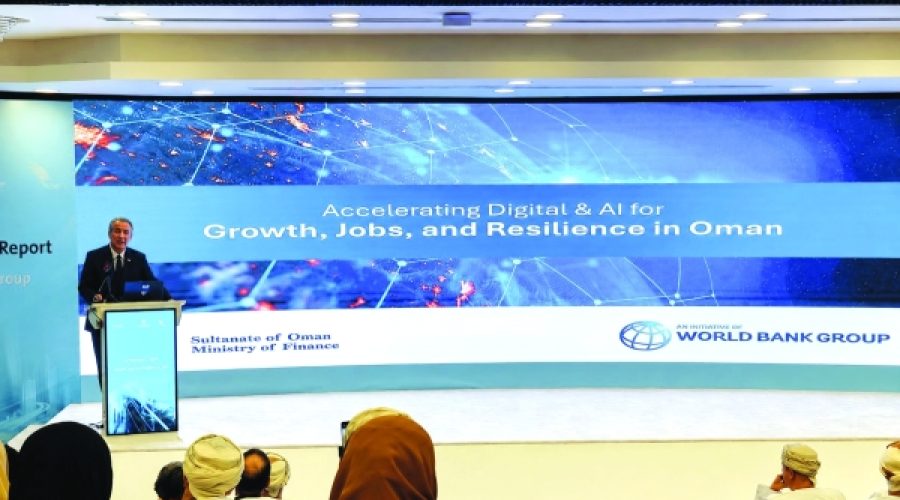
This key insight was shared last Thursday by Zaki Badie Khoury, Senior Digital Specialist at the World Bank Group, during a presentation in Muscat that explored digital transformation trends across the GCC and assessed Oman’s readiness for the AI era.
Khoury highlighted Oman’s significant progress over the past decade in broadband connectivity, digital government services, regulatory frameworks, and cybersecurity, positioning the nation among the leading performers in the region for institutional digital preparedness.
“The foundation is extremely strong,” Khoury stated. “We have all the essential elements in place to build upon.”
The presentation detailed Oman’s near-universal 4G coverage and robust 5G deployment, alongside marked advances in government digital services and cybersecurity capabilities. Khoury described Oman as one of the GCC’s most advanced countries regarding regulatory and institutional frameworks that support digital transformation. He emphasized the country’s notable cybersecurity capabilities, calling them vital safeguards for accelerating digital economic activities.
Despite these advancements, Khoury warned that future economic competitiveness in the Gulf will depend less on basic digital infrastructure and more on capabilities in AI, advanced skills development, private-sector innovation, and substantial investment.
“Oman remains at an emerging stage compared to other GCC countries in preparing the public sector and government to fully leverage AI,” Khoury explained.
The presentation also highlighted growing investment disparities between Oman and regional leaders such as the UAE and Saudi Arabia, which are rapidly expanding AI ecosystems, data centers, and advanced digital industries as part of their broader economic diversification efforts.
Khoury identified Oman’s key challenge as moving beyond digitalisation to convert its existing digital infrastructure into tangible economic growth and job creation.
“It is now time to capitalize on our digital foundations to drive greater growth and employment,” he urged.
According to the presentation, Oman’s digital economy currently accounts for only 2.4 to 2.8 percent of GDP, significantly below the Oman Vision 2040 target of 10 percent by the strategy’s conclusion.
Stronger AI adoption and increased digital investment were highlighted as critical for developing new non-oil growth sectors, supporting Oman’s efforts to reduce long-term dependence on hydrocarbons.
Khoury noted that neighboring countries are investing substantially more in AI and digital technologies, while Oman still has wide scope to enhance investment levels and attract foreign direct investment into advanced technology industries.
A major advantage for Oman is its young population, with approximately 64 percent under the age of 30. Khoury identified this demographic factor as a significant opportunity to cultivate advanced digital and AI skills, provided it is supported by education reform and specialized training programs.
Progress has already been made through initiatives in digital education, e-government reforms, and early AI adoption in select sectors. However, Khoury emphasized that future success will depend critically on execution speed and increased private-sector participation.
“The key to Oman’s transition into the AI era is agility,” he remarked.
Another important message was the strategic value of data as an economic asset. Khoury pointed to the health, education, and energy sectors as major sources of valuable national data. He stressed that making these data sets accessible to the private sector is essential to spur innovation and AI development.
“To truly foster innovation, data must be open to the private sector,” he said.
The presentation underscored the necessity for stronger public-private collaboration if Oman intends to accelerate digital transformation beyond the public sector, where most GCC digital investments have traditionally concentrated.
Khoury also highlighted the employment potential associated with modest growth in the digital economy.
“An increase of just two percent in the digital economy’s contribution to GDP could create 30,000 new jobs,” he noted.
This presentation arrives amid intensifying competition among Gulf countries to establish themselves as regional hubs for AI and advanced technology, as the global race for digital infrastructure, cloud computing capacity, semiconductor ecosystems, and sovereign data capabilities gains momentum.
Special Analysis by Omanet | Navigate Oman’s Market
Oman has established a strong digital and cybersecurity foundation, placing it ahead in the region for institutional readiness. However, the next critical step involves leveraging AI to drive meaningful economic growth, job creation, and reduce hydrocarbon dependence. Smart investors and entrepreneurs should focus on accelerating AI adoption, fostering private-sector innovation, and capitalizing on Oman’s youthful population and strategic data assets to unlock competitive advantages in the emerging digital economy.