Oman’s Strong Position Against Regional Shocks: What It Means for Investors and Business Owners
MUSCAT — Oman’s fiscal reforms and economic diversification efforts have significantly enhanced the country’s capacity to withstand regional shocks, positioning it as one of the least affected economies in the Gulf Cooperation Council (GCC) amid ongoing geopolitical tensions, the World Bank has stated.
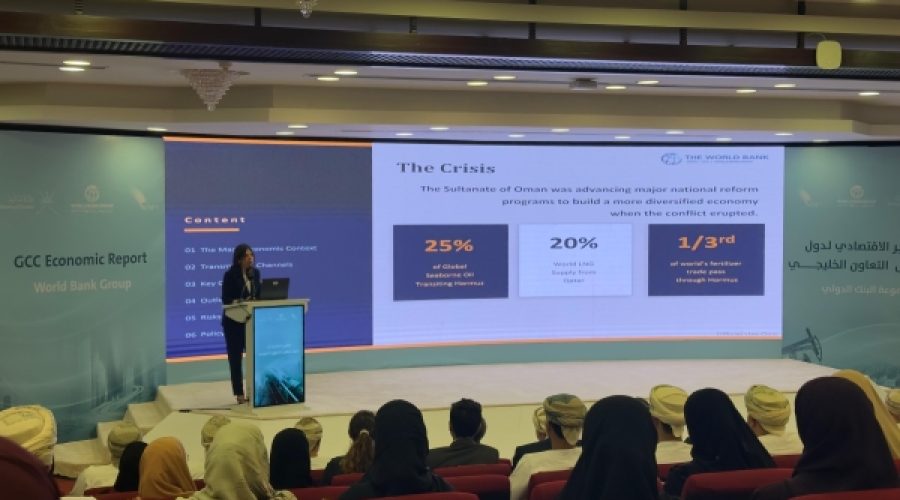
During a presentation on the World Bank’s Gulf Economic Update 2025, economist Hoda Youssef highlighted that Oman’s development of alternative trade routes, an improving fiscal position, and a growing non-oil economy have served as critical buffers against disruptions impacting the broader region.
Youssef underscored the strategic importance of the Strait of Hormuz, which handles about 25% of global oil trade, and Qatar’s role in supplying nearly 20% of the world’s liquefied natural gas (LNG). She also pointed out that the Gulf region accounts for approximately one-third of global fertiliser trade, a vital element for food production and security worldwide.
“Oman is uniquely positioned among GCC countries due to its alternative trade routes, making it less vulnerable to disruptions such as a potential closure of the Strait of Hormuz,” Youssef explained.
The World Bank projects Oman’s economy to grow by 2.4% in 2026, with a current account surplus expected to reach 3.4% of GDP and a fiscal surplus of around 3.2%. These positive forecasts are supported by higher oil and fertiliser prices, alongside government initiatives to improve spending discipline and enhance tax collection.
The report also praised Oman’s fiscal consolidation program as a leading example within the region, noting progress in debt reduction and better management of oil revenue windfalls under Vision 2040 and the Medium-Term Fiscal Plan. “Oman has made significant strides in bolstering economic resilience and laying the groundwork for sustainable growth,” the report stated.
The presentation also revealed that the GCC region entered the current crisis from a relatively stable macroeconomic position, with regional growth projected at 2.6% in 2025, driven largely by non-oil sectors, while inflation remained controlled in most Gulf economies.
However, Youssef cautioned that ongoing conflicts have impacted not only energy markets and shipping routes but also tourism, aviation, and logistics sectors across the GCC. Tourism, which contributes roughly 4% to Oman’s GDP, has been notably affected by regional instability.
She further explained that increased freight and insurance costs—resulting from vessels taking longer alternative shipping routes—have driven up transportation expenses and contributed to global inflationary pressures.
Rising fertiliser prices are a growing concern for food-importing nations due to their impact on food security and staple commodity prices. Nevertheless, Oman’s status as a fertiliser exporter offers short-term fiscal and external balance benefits.
Despite the generally favourable outlook, the World Bank warned that investor confidence remains a significant economic risk for the region. Youssef emphasized that restoring foreign direct investment flows will require sustained efforts post-crisis, focusing on strengthening economic resilience and maintaining policy credibility.
In the short term, GCC governments should prioritise stabilisation measures that support financial systems, supply chains, and liquidity for sectors affected by the crisis, particularly tourism.
The analysis also addressed the GCC’s broader economic diversification initiatives, noting Oman’s visible progress in increasing non-oil exports and improving its position on the Economic Complexity Index, which tracks advances toward higher value-added production.
Nonetheless, the World Bank cautioned that diversification across the GCC remains incomplete, with many governments still heavily reliant on hydrocarbon revenues.
These insights were shared during a session reviewing the World Bank’s latest Gulf Economic Update titled “Smart Spending, Stronger Outcomes: Fiscal Policy for a Thriving GCC.”
Special Analysis by Omanet | Navigate Oman’s Market
Oman’s fiscal reforms and economic diversification have fortified its resilience against regional geopolitical risks, positioning it as one of the least impacted GCC economies. For businesses and investors, this underscores opportunities in non-oil sectors like fertilisers and alternative trade routes, while cautioning on the need to navigate inflationary pressures and global supply chain shifts. Smart investors should focus on sectors benefiting from Oman’s strategic buffers and reforms, leveraging the country’s stable fiscal outlook and Vision 2040 initiatives to capitalize on sustainable growth potential.