Trump Warns Iran Blockade Could Last Months: What It Means for Oil Markets and Your Investment Strategy
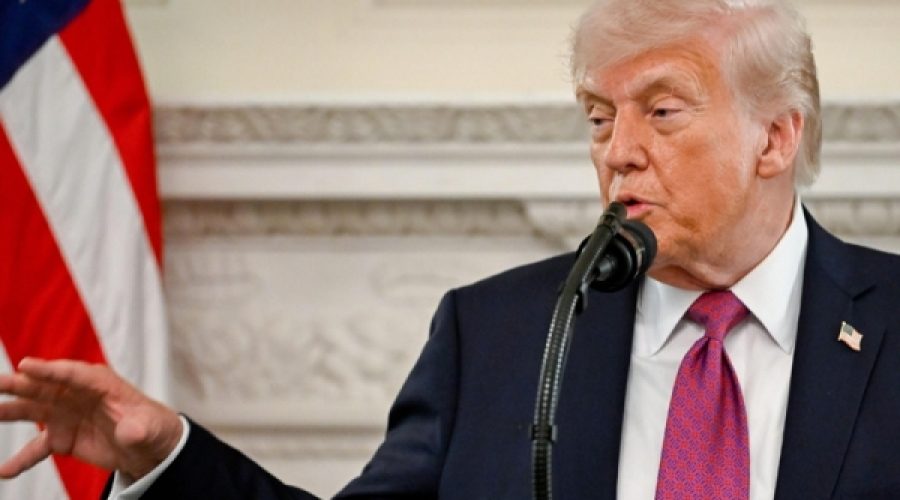
President Donald Trump announced that a U.S. naval blockade against Iran could continue for several months, causing oil prices to soar to their highest levels in over four years, a trend that persisted into Thursday.
With diplomatic efforts between Washington and Tehran stalled after several unsuccessful attempts, Trump held a phone conversation on Wednesday with Russian President Vladimir Putin, who cautioned against the “damaging consequences” that could arise if the U.S. and Israel resumed hostilities against Iran.
Addressing oil industry leaders, Trump asserted that the blockade of Iranian ports — a condition Tehran insists upon before any agreement — is more effective than military strikes.
The U.S. Central Command (CENTCOM) reported on X (formerly Twitter) that it had achieved a “significant milestone” by successfully diverting the 42nd commercial vessel attempting to breach the blockade. CENTCOM highlighted that 41 tankers carrying a total of 69 million barrels of oil remain unsold by Iran, estimating the value at over $6 billion.
Trump faces mounting political pressure to end the conflict, which has grown unpopular even among portions of his base, raised fuel costs for American consumers, and unsettled U.S. allies.
According to a White House official speaking anonymously, Trump discussed in a Tuesday meeting efforts “to alleviate global oil markets” and strategies to prolong the blockade for several months if necessary, while seeking to minimize the impact on American consumers.
In an interview with Axios, Trump described the naval blockade, saying, “They are choking like a stuffed pig. And it is going to be worse for them.”
Oil prices surged to four-year highs, with the U.S. benchmark Brent crude for June delivery climbing over five percent to $124.81 per barrel, and West Texas Intermediate increasing about two percent, surpassing $109 per barrel.
Iran has leveraged control over the Strait of Hormuz—a critical, narrow waterway through which approximately 20% of the world’s oil typically passes—to exact a cost in response to attacks.
The issue, Trump emphasized, remains centered on Iran’s nuclear ambitions.
On Wednesday, Trump criticized German Chancellor Friedrich Merz, threatening to reduce American troop presence in Germany due to Berlin’s refusal to support the conflict with Iran or contribute to a peacekeeping mission in the Strait of Hormuz. Merz has been a target of Trump’s criticism after remarking that Iran is “humiliating” the U.S. during negotiations.
Key U.S. officials, including Vice President JD Vance, canceled trips to Pakistan last week intended to open dialogue with Iran, which remains skeptical about the sincerity of U.S. diplomacy.
U.S. authorities acknowledge uncertainty about who represents Iran’s negotiating stance—whether the hardline, growingly powerful Revolutionary Guards or the diplomatic corps—following Israeli strikes that eliminated several senior Iranian figures.
The United Nations Development Programme (UNDP) has warned that the conflict, which has also caused fertilizer prices to spike, risks pushing over 30 million people into poverty across 160 countries. UNDP chief Alexander De Croo described the situation as “development in reverse.”
Despite Tehran’s defiance, the Iranian rial plummeted to historic lows against the U.S. dollar, and residents expressed despair. One 52-year-old architect in Paris told AFP that past negotiations have only worsened the economic situation due to intensified sanctions. He commented, “The issue is always nuclear. There’s no talk about people, the economy or freedom. People have the right to not even want to hear the word ‘negotiation.'”
Iran has suggested it might ease its control over the Strait of Hormuz if the U.S. lifts its blockade and broader negotiations occur, though the Trump administration remains skeptical.
Iranian parliamentary speaker Mohammad Bagher Ghalibaf, a prominent figure since the conflict began, charged that the U.S. naval blockade aims to sow division and make Iran “collapse from within.”
Violence continues on the Lebanon front of the conflict despite a recently extended ceasefire between Israel and Hezbollah, the Iran-supported group whose rocket attacks on Israel drew Lebanon into the war. Israel responded with airstrikes and a ground incursion.
For the first time since the ceasefire, the Lebanese army reported that an Israeli strike on Tuesday targeted its troops in the south, wounding two soldiers. Another strike on Wednesday killed one Lebanese soldier.
Lebanese President Joseph Aoun urged Israel to recognize that lasting security depends on negotiations, stressing that Israel must fully implement the ceasefire before dialogue can proceed. He condemned ongoing Israeli attacks, stating, “Israeli attacks cannot continue as they are.”
A UN-backed report released Wednesday warned that over 1.2 million people in Lebanon are expected to face acute hunger as a consequence of the recent conflict.
Special Analysis by Omanet | Navigate Oman’s Market
The ongoing US naval blockade on Iran and the resulting spike in oil prices to four-year highs pose both risks and opportunities for businesses in Oman, a key player in the regional energy market. Rising oil prices can boost local revenues and investments in energy infrastructure, yet the geopolitical volatility and potential for extended conflict underscore the need for risk mitigation strategies and diversification. Smart investors and entrepreneurs should prioritize monitoring geopolitical developments closely and exploring opportunities in alternative sectors alongside traditional oil investments to navigate the uncertain regional landscape effectively.