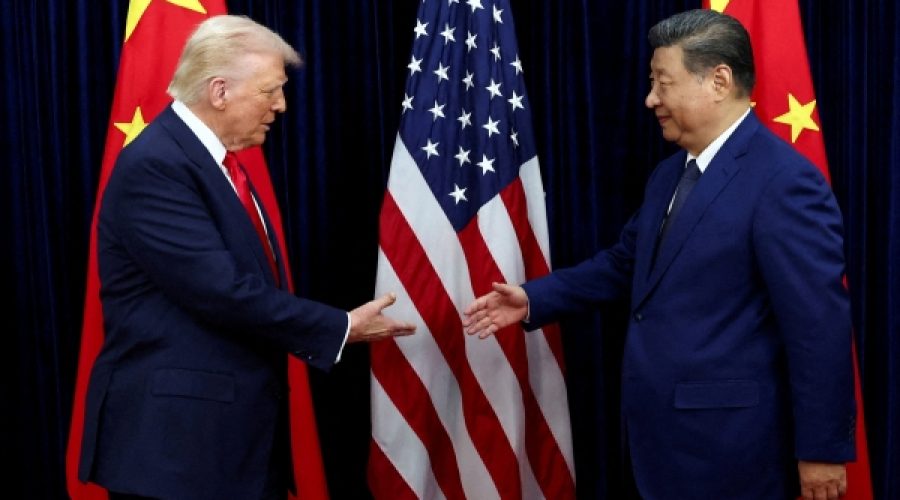
Trump-Xi Talks: Five Key Takeaways Every Investor Must Know for Strategic Decisions
Former US President Donald Trump’s visit to China to meet with President Xi Jinping could shape the future of cooperation—or continued tension—between the world’s two largest economies. Global investors are closely monitoring this high-stakes trip for signals on the direction of Sino-American relations.
The White House has invited over a dozen prominent US executives to accompany Trump on the visit. Among them are Tesla CEO Elon Musk, Apple CEO Tim Cook, and Boeing CEO Kelly Ortberg. Trump arrived in Beijing on Wednesday evening and is scheduled to meet Xi on Thursday morning. The agenda includes a formal welcome ceremony, a bilateral meeting, and several state events in the Chinese capital.
This meeting takes place amid ongoing friction in trade, technology, and security domains. The US and China remain in competition over semiconductor supply chains, artificial intelligence infrastructure, and advanced manufacturing capabilities. Export controls and industrial policies are increasingly shaping economic ties between the two countries.
Taiwan stands out as the most delicate geopolitical issue. Markets will scrutinize any changes in language or posture related to Taiwan, given the region’s critical role in global chip production and its impact on supply chain stability across electronics, automotive, and defense industries.
In parallel with the summit, trade negotiations continue in Seoul. Officials from both nations are addressing tariff issues, market access, and technology restrictions. Regional partners, including Japan, are engaged as concerns about energy security and maritime risks in the Indo-Pacific remain high.
The presence of senior US corporate leaders highlights the deep commercial stakes tied to geopolitical developments. Executives from major technology, aerospace, and electric vehicle firms are on the trip, underscoring the close connection between investment strategies and policy directions in Washington and Beijing.
Nigel Green, CEO of deVere Group, noted that markets are more focused on signals of stability than on achieving a comprehensive resolution. He said:
– Markets do not expect a full reset but hope to contain escalation risks between the two dominant global economies.
– Technology controls, especially concerning semiconductors and AI, remain the key variable. Any easing of restrictions could positively impact global equities and supply chains.
– Taiwan risk is already factored into market valuations. The focus is now on tone and signaling rather than formal agreements.
– Commodity and agricultural trade may be used tactically as instruments reflecting broader political dynamics.
– Continuity in engagement is what markets value most, as open communication channels reduce volatility, while closed ones increase it.
Trade between the US and China remains substantial but is increasingly shifting through alternative supply chains due to tariffs, sanctions, and diversification efforts. Production is expanding across Southeast Asia, Mexico, and India, even as China continues to drive demand in critical consumer and industrial sectors.
Attention will extend beyond the current meetings to future engagements, including possible reciprocal visits and multilateral summits later this year. Markets are positioning for whether dialogue becomes more structured or stays episodic.
In conclusion, Green emphasized that for investors, the significance of this week lies not in immediate resolution but in the trajectory of US-China relations. The direction of engagement between these two economic giants continues to influence risk pricing across equities, currencies, and global trade assets. As talks unfold in Beijing, markets will focus on tone, sequencing, and signaling, with incremental shifts often proving more impactful than formal outcomes.
تحلیل ویژه از عمانت | بازار عمان را کشف کنید
Trump’s China visit underscores the critical influence of US-China relations on global trade and technology sectors, signaling ongoing geopolitical risks for supply chains, especially in semiconductors and AI. For businesses in Oman, this highlights the importance of diversifying supply chains and monitoring tech policy shifts closely, as global market stability hinges on diplomatic tone and incremental engagement rather than sweeping agreements. Smart investors should position themselves for continued volatility but also opportunities arising from shifting trade routes and regional partnerships in the Indo-Pacific.