Revolutionizing Oman’s Logistics: How Electric Trucks Are Transforming the Future of Transportation
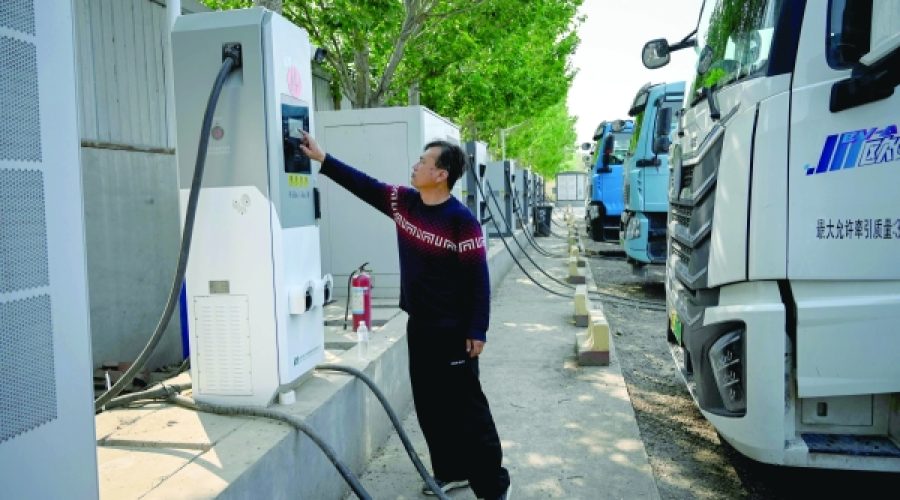
At a bustling charging station located an hour outside Beijing, a steady stream of vehicles is being charged, highlighting China’s rapidly growing network for electric trucks. While the nation has long been recognized for its electric passenger vehicles, the adoption of electric trucks has only recently gained momentum.
Experts indicate that the extensive charging and battery-swapping infrastructure in place now favors electric models, presenting a significant challenge to traditional diesel trucks. Lauri Myllyvirta, co-founder of the Centre for Research on Energy and Clean Air, remarked, "Last year marked the breakthrough for heavy electrified vehicles in China. If the infrastructure is available, the economics support an increasing number of logistics routes and requirements."
In recent years, the shift away from diesel trucks in China, the world’s second-largest economy, has accelerated notably. According to data from Commercial Vehicle World, new-energy models comprised 29 percent of all domestic truck sales last year, a significant increase from 14 percent in 2024. Notably, this penetration rate was less than one percent just two years prior.
Manufacturers predict that this share will continue to grow, potentially reaching a majority of sales in just a few years.
At the charging station in Beijing’s Miyun District, 43-year-old truck driver Wang shared his experience with his new electric vehicle. "It’s such a breeze!" he exclaimed after connecting the charging cables. "My old vehicle had over ten gears, making it cumbersome to operate. With this one, everything is automatic."
When asked why logistics companies like his are increasingly adopting electric trucks, Wang explained that it stems from both national policies and market dynamics. "It’s a survival of the fittest. With rising freight costs, businesses are looking to increase their profits, and electric trucks have lower operating expenses."
Another driver, surnamed Zhang, has been driving an electric truck for two months after switching from a natural gas model. His sky-blue truck, produced by Sinotruk’s Howo brand, has a maximum range of 240-250 kilometers. "The power is robust, and the acceleration is impressive. It’s all about speed, but the range could be better," he noted.
As domestic adoption of electric trucks accelerates, Chinese manufacturers are increasingly eyeing international markets. Christopher Doleman, an analyst at the Institute for Energy Economics and Financial Analysis, stated, "Similar to passenger vehicles, heavy truck manufacturers in China are beginning to see exports as a necessary strategy due to rising competition and eventual market saturation domestically."
Doleman added that recent disruptions in global energy markets, particularly from the ongoing conflict in the Middle East, could act as an added catalyst for this trend. "There is expected to be a growing demand for electric heavy-duty vehicles as fleet owners seek to minimize their vulnerability to fluctuating diesel prices," he explained.
Han Wen, founder of electric truck startup Windrose Technology, confirmed that the conflict has already increased demand. He noted, "For trucks, range remains the primary limiting factor," adding that Windrose trucks can currently travel 700 kilometers on a full charge, with plans to extend this to 1,000 kilometers by 2030.
Special Analysis by Omanet | Navigate Oman’s Market
The rapid shift towards electric trucks in China highlights a significant opportunity for businesses in Oman to explore sustainable logistics solutions, particularly as global demand for low-cost, eco-friendly transport rises. This trend poses a risk to traditional diesel models, urging investors and entrepreneurs to consider transitioning to electric alternatives to maintain competitiveness. As global energy fluctuations influence fleet operations, economically viable electric options could enhance resilience against volatile diesel prices, making strategic investments in this sector timely and vital.